
I once spent weeks building a platform for a digital product idea I was convinced would work. I planned the branding, imagined the launch, and mentally spent money I had not even made yet. I never once asked a stranger if they would actually pay for it. When I finally launched the product, silence. No sales, no enquiries, nothing except likes. The idea was not bad. It was simply unvalidated. I had fallen in love with my own assumption instead of testing reality.
That expensive lesson taught me something every founder eventually learns, usually the hard way: the goal is not to prove your idea is brilliant, it is to find evidence that real people are willing to pay for it. In this article, we are going to look into exactly how to validate a product or business idea before you launch, so you spend your time and money building something people actually want.
What Does It Mean to Validate a Business Idea?
Business idea validation is the process of gathering real evidence, not opinions, not assumptions, not compliments from friends, that genuine demand exists for what you want to sell, before you invest significant time or money building it.
Validation is not about confidence. You can feel completely certain your idea is good and still be wrong, because confidence is an internal feeling, while validation is an external, measurable signal. The entire point of validation is to separate what you believe people want from what people are actually willing to pay for.
Why Most Business Ideas Fail
Research consistently shows that a lack of market need is one of the top reasons startups fail, not bad execution, not insufficient funding, but simply building something nobody wanted enough to pay for. This single insight should reshape how you approach every new idea.
I have watched this happen repeatedly, seen people blame themselves on Reddit, Facebook, Quora, and X for their SaaS startup failures. I even made this exact mistake myself. You get excited about a solution before confirming the problem is real and painful enough for people to pay to solve it. While excitement feels like validation, it is not. It is just excitement.
How to apply this: Before you build anything, separate your enthusiasm for the idea from actual proof that it solves a real problem for real people. These are two completely different things, and confusing them is where most failed ideas begin.
Start With a Real Problem, Not a Cool Idea
The strongest businesses do not start with “wouldn’t it be cool if…” They start with “this is genuinely frustrating, and I want to fix it.” A real problem is something people are already actively trying to solve, searching for answers, complaining about, or paying for imperfect alternatives.
When I eventually rebuilt my approach to business ideas, I stopped asking “what could I create?” and started asking “what are people already struggling with that I understand well enough to solve?” That single shift in starting point changes everything about how validation unfolds afterward.
How to apply this: Write down the specific problem your idea solves in one sentence. If you cannot state a clear, specific problem, not a vague “people need this” but an actual pain point, your idea needs more work before validation can even begin.
Define Your Target Audience Precisely
You cannot validate an idea for “everyone.” Vague audiences produce vague, unreliable validation signals. Defining your target audience means getting specific about who experiences this problem most intensely, like their age, their situation, their behavior, and importantly, whether they have the ability and willingness to pay for a solution.
How to define your target audience: Describe your ideal early customer in detail. Not a broad demographic, but a specific type of person you could picture messaging directly. Precision here makes every subsequent validation step sharper and more reliable.
Do Market Research Before You Create Anything
This is my biggest weak point and where I went wrong originally. I built before I researched. Market research means investigating whether your assumed problem and audience actually exist at the scale and intensity you believe, before spending time creating a solution.
Read, How to Position Your Product or Service So It Sells Itself
What you personally think is a good idea might not actually attract anyone. This is one of the hardest lessons in business, because your own excitement genuinely feels like evidence, but it is not. Only external signals from real potential customers count as evidence.
How to do market research: Search online for how people currently describe this problem. Are they searching for solutions? Complaining in forums or comment sections? Already paying for imperfect workarounds? These signals tell you whether the market exists before you invest in creating anything for it.
Study Your Competitors Closely
If competitors already exist solving a similar problem, that is not automatically bad news; it often confirms genuine market demand. The real question becomes: what are they doing well, where are they falling short, and is there a specific gap you could fill better than they currently do?
How to study your competitors: Identify three to five competitors or alternative solutions for your SaaS business. Study their pricing, their customer reviews, and their complaints. Negative reviews of competitors are often the clearest map of exactly what an underserved audience still wants.
Talk Directly to Your Potential Customers
Nothing replaces direct conversation with real potential buyers. Surveys and data are useful, but a genuine conversation reveals nuance, such as hesitations, specific language, and emotional triggers that numbers alone cannot capture.
How to relate with your potential customers: Reach out directly to 10 to 15 people who match your target audience. Ask about their current frustrations with this problem, what they have already tried, and what would make them genuinely excited to pay for a better solution. Listen far more than you talk.
Test Interest Before You Build Anything
This is the single most expensive mistake I see repeatedly on Reddit every time, including in my own early experience. People spend months, sometimes years, building a full product or business, only to discover afterward that it is genuinely difficult to market and sell. Thousands of dollars and countless hours get poured into something that was never actually validated, and the painful realization only arrives after the money is already spent.
How to test interest before building: Run a small ad campaign with a modest budget promoting the concept of your product before it exists, and measure the response. A simple landing page describing the offer, paired with a small amount of traffic, tells you far more about real demand than any amount of internal confidence ever could.
Build a Minimum Viable Product (MVP)
A minimum viable product, or MVP, is the simplest possible version of your idea that lets you test real demand without building the complete, polished version. This could be a basic prototype, a simple version of your service delivered manually, or even just a detailed demo showing how the finished product would work.
How to apply this: Ask yourself what the absolute simplest version of your idea would look like. Something you could create in days rather than months that still lets a real customer experience the core value you are offering.
Real-World Examples of Validation Done Right
These examples are not theoretical; they are some of the most well-known validation stories in startup history, and they illustrate exactly why testing before fully building matters.
Dropbox: famously validated demand using a simple demo video before building the full, complex file-syncing product. The video explained the concept clearly, and the massive spike in sign-ups it generated proved genuine demand existed before a single line of the final product was built.
Airbnb: started small and scrappy. The founders simply rented out air mattresses in their own apartment during a local conference when hotels were fully booked. That tiny, low-risk experiment proved people would actually pay to stay in a stranger’s home, long before Airbnb became the global platform it is today.
Buffer validated demand for their social media scheduling tool with a simple landing page describing the product and its pricing, before the actual software existed. When enough people clicked through and expressed genuine interest in paying, that data justified building the real product.
Notice the pattern across all three: none of these companies built the complete, polished product first. They tested the core assumption by asking a simple question: “Will people want and pay for this using the smallest possible version of the idea?
Test Your Pricing Early
Pricing is not something to figure out after launch. It is part of validation itself. Testing whether people are willing to pay a specific amount tells you something fundamentally different from testing whether people simply like your idea in theory.
Read, What Is Branding? How to Build a Brand People Trust and Remember
How to test your pricing with a small audience: Even before your product fully exists, present a specific price alongside your concept when gathering feedback or running small tests. Genuine interest at a real price point is a far stronger signal than vague enthusiasm with no financial commitment attached.
Measure the Right Signals
Not all positive feedback is equally meaningful. Vanity signals like generic compliments and casual encouragement from friends feel good but rarely predict actual buying behavior. Real signals like email sign-ups, pre-orders, landing page conversion rates, and genuine payment commitments indicate that people are willing to act, not just react politely.
How to apply this: Track specific, measurable actions rather than general sentiment. An email address given in exchange for early access means significantly more than a comment saying “this sounds cool.”
Pay Close Attention to Customer Feedback
Once you have any real interest, like sign-ups, initial buyers, and MVP testers, their feedback becomes some of your most valuable validation data. What confused them? What almost stopped them from buying? What did they wish was different?
How to apply this: Create a simple, direct way for early testers or customers to share honest feedback, and treat critical feedback as more valuable than praise. Criticism reveals exactly what to fix before a wider launch; praise mostly just feels nice.
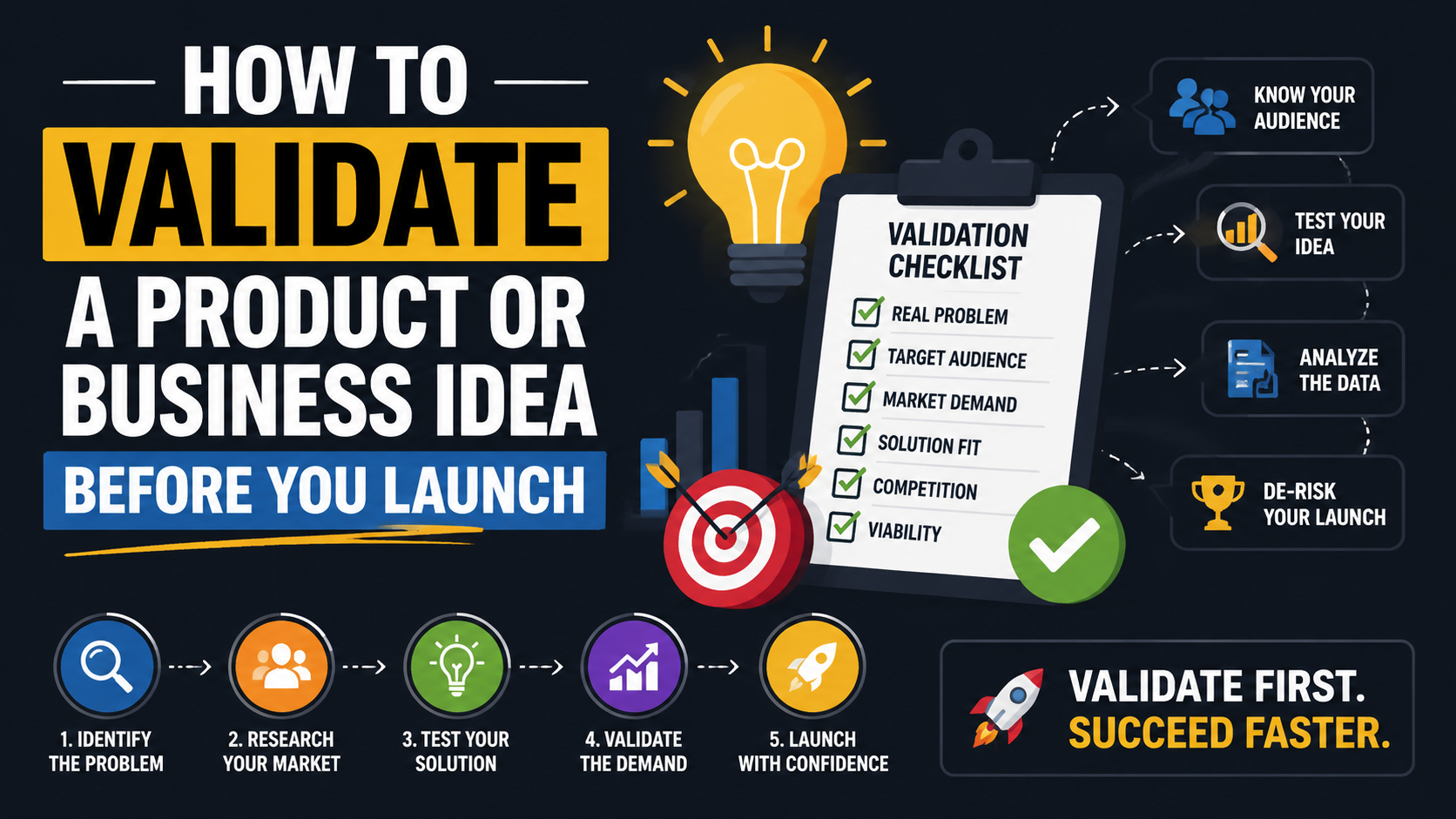
Step-by-Step Validation Checklist
Step 1 — Identify a real, specific problem, not a vague idea you find personally exciting.
Step 2 — Define your target audience precisely, including their willingness and ability to pay.
Step 3 — Research the existing market to confirm the problem and demand genuinely exist at scale.
Step 4 — Study competitors to identify gaps and opportunities your idea could fill better.
Step 5 — Talk directly to 10 to 15 potential customers to gather real, nuanced insight.
Step 6 — Test interest with a small ad campaign or landing page before building anything substantial.
Step 7 — Build a minimum viable product like the simplest version that still delivers core value.
Step 8 — Test real pricing, not just theoretical interest.
Step 9 — Measure genuine signals like sign-ups, pre-orders, conversions and not vanity metrics.
Step 10 — Gather and act on early customer feedback before any full-scale launch.
What I Would Do Differently Today
Looking back at my own early mistake, which was building an idea nobody had asked for, the fix was never about working harder or being more creative. It was about testing smaller and earlier, before my time and money were already committed. If I had spent even a small ad budget testing genuine interest before building anything, I would have known within days, not months, whether the idea deserved my continued effort.
Validation is not about killing your excitement for an idea. It is about protecting your time and money by finding real evidence before you commit fully, exactly the evidence that Dropbox, Airbnb, and Buffer each found before building anything close to their final product.
Frequently Asked Questions
How much does it cost to validate a business idea?
Validation can often be done with a very small budget. Sometimes under $50 for a simple landing page and a small test ad campaign. The goal is to gather a genuine signal cheaply, not spending significantly before you have any evidence of demand.
How long should validation take before I start building?
This varies by idea complexity, but meaningful validation signals such as landing page conversions, direct customer conversations, and small ad test results can often be gathered within one to two weeks of focused effort, well before committing months to full development.
What if people say they like my idea but do not sign up or pay?
This is one of the most important validation lessons: verbal enthusiasm without action is not reliable validation. Politeness makes people say nice things. Only measurable actions such as an email address, a pre-order, or an actual payment reliably predict real future buying behavior.
Leave a Reply