
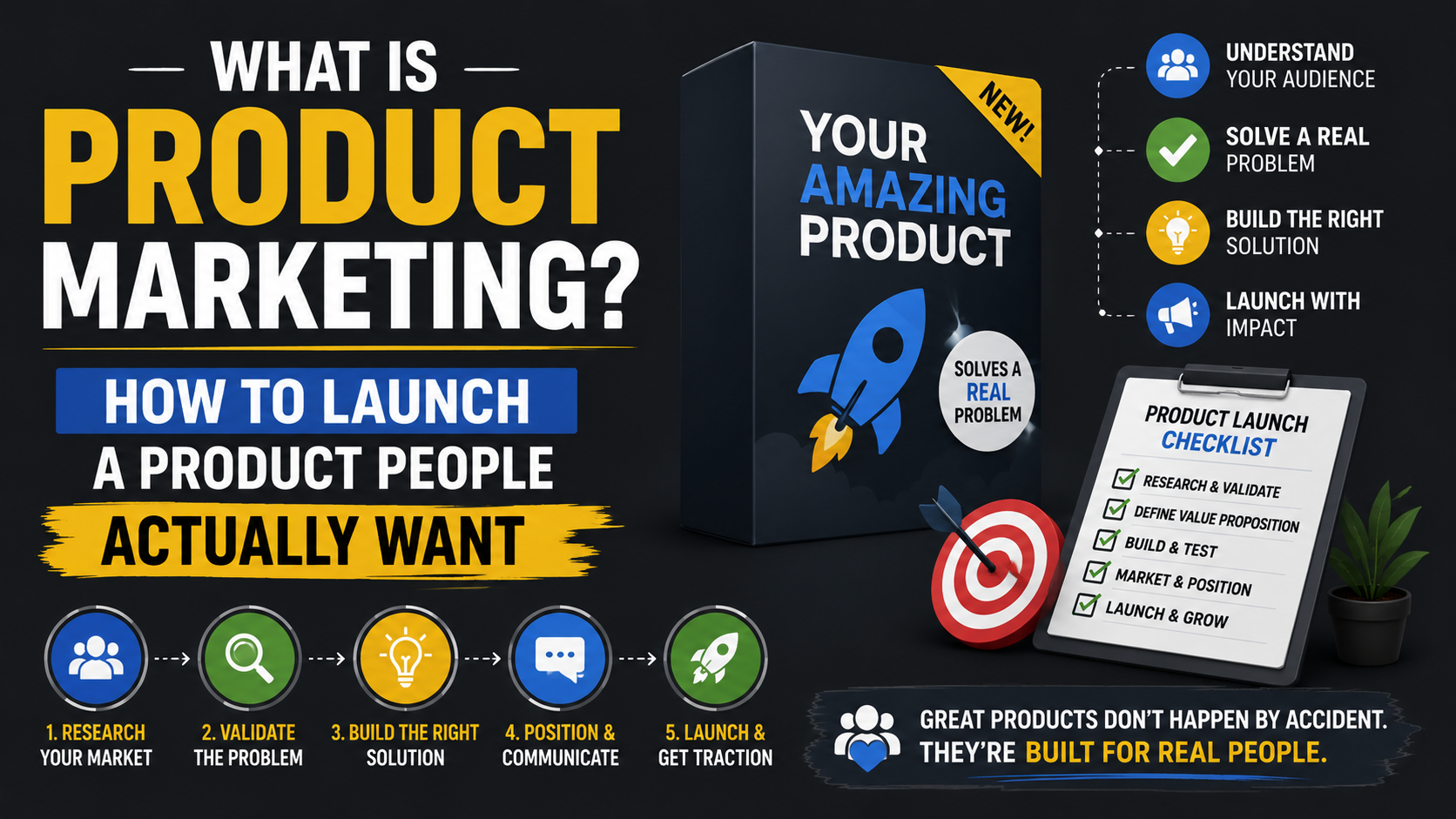
In early 2025, I spent weeks preparing to launch a new product. I wrote the description carefully, edited it repeatedly, designed clean product images, and picked what I thought was a fair price. I was confident. I hit publish expecting sales to follow naturally, because I genuinely believed I had built something good. Weeks passed. Zero sales. Not one. All that effort, and I could not understand what had gone wrong until I realized the problem had nothing to do with how well I wrote the description or how polished the images looked.
The problem was that I had skipped product marketing entirely. I had gone straight from idea to launch without ever confirming the market actually wanted this specific product, without shaping how it should be positioned, and without a plan for how the right people would even discover it. In this article, I will break down exactly what product marketing is and how to launch something people genuinely want to buy, the process I wish I had followed before that failed launch.
What Is Product Marketing?
Product marketing is the practice of understanding your market, shaping how your product is positioned and communicated, and making sure the right people see its value before, during, and after launch. A common misconception that I fell into completely is that product marketing begins at launch. In reality, it starts much earlier, with understanding your customer, and it continues long after your first sale.
Product marketing vs general marketing: General marketing covers the broad activity of promoting a business, while product marketing focuses specifically on one product: understanding who it is for, how it should be positioned, and how to communicate its value clearly.
Product marketing vs product management: Product management focuses on building and improving the product itself, while product marketing focuses on ensuring the right people understand and want what has been built.
Product marketing vs sales: Sales focuses on individual conversations and closing deals, while product marketing creates the positioning, messaging, and market understanding that makes those sales conversations easier in the first place.
Why Product Marketing Matters
When I skipped this process, I lost weeks of effort and whatever confidence I had going into that launch. When done properly, product marketing produces stronger product-market fit, clearer positioning, higher conversion rates, faster adoption, and more successful launches. It is the difference between hoping people will buy and knowing, based on real evidence, that they will.
The Product Marketing Lifecycle: It Does Not End at Launch
This was my biggest misunderstanding. I treated launch day as the finish line. In reality, product marketing is a continuous cycle: market research, customer discovery, positioning, messaging development, launch planning, customer education, adoption, ongoing improvement, and eventually updates or repositioning as the market shifts.
Understanding this cycle would have shown me that my “launch” was actually the middle of the process, not the beginning or the end.
How to Launch a Product People Actually Want
Start With Customer Research
I skipped this step entirely in early 2025. I assumed I understood what customers wanted based on my own instincts, without actually confirming it with real people first.
Customer research means talking to potential buyers directly, studying their pain points, understanding what they have already tried, and identifying genuine gaps in existing alternatives. When I eventually went back and asked real customers directly what frustrated them about buying watches online, the answers surprised me. It was concerns I had never addressed in my failed product’s description at all.
How to resolve this: Before building or launching anything, talk to 10 to 15 real potential customers. Ask what they currently struggle with, not what they think of your idea in the abstract.
Understand Your Target Market Precisely
A product cannot appeal to everyone equally, and trying to make it do so is exactly why my early messaging felt so generic. Define your ideal customer profile, such as their age, lifestyle, income level, and specific motivations for buying.
When I eventually narrowed my own audience to professionals who wanted to look successful without paying luxury prices, every subsequent marketing decision became sharper and more effective than the vague “anyone who likes watches” approach I originally used.
Define Your Product Positioning
Product positioning shapes how customers perceive your product relative to alternatives. It is not what your product literally is. Rather, it is where it sits in your customer’s mind.
Read, What Is Marketing Automation? How to Sell While You Sleep
My failed 2025 launch had no clear positioning at all. I described features like materials, design details without ever answering the question every customer silently asks: why does this matter to me specifically, right now? A unique selling proposition answers exactly that, and I simply had not defined one before launching.
Craft Messaging That Connects
Messaging is how you communicate your product’s value, like your website copy, your captions, and your sales conversations. My original product description focused heavily on features and almost entirely ignored outcomes and benefits.
Compare “genuine leather strap, stainless steel case” to “a watch that makes people notice you the moment you walk into the room.” The second version sells an outcome. The first just describes an object. This single shift, moving from features to benefits, was one of the clearest lessons from studying why my launch failed.
Analyze the Competition Before Launching
I never properly studied competitors before that first launch, which meant I had no idea whether my pricing, positioning, or messaging offered anything genuinely different. Competitor research, such as studying their pricing, their customer reviews, and where their messaging falls short, reveals exactly where your opportunity to differentiate actually exists.
When I eventually did this research properly for later products, negative reviews on competitor pages consistently revealed unmet customer expectations I could directly address in my own positioning.
Prepare Properly for Launch
A real launch plan includes clear goals, a realistic timeline, the specific marketing channels you will use, and all your launch assets ready in advance, such as your landing page, your social content, and your email sequence if you have a list.
My 2025 launch had none of this structure. I simply posted the product and hoped. There was no coordinated plan pulling multiple channels together toward the same moment.
Choose the Right Marketing Channels for Your Product
Different products succeed through different channels. A product requiring visual desire, like watches or jewelry, often performs best through Instagram and Facebook. A product solving a specific searchable problem may perform better through SEO and content marketing.
How to apply this: Choose channels based on where your specific target audience already spends time and how they naturally search for or discover products like yours, rather than posting everywhere with no clear strategy.
Build a Simple Go-to-Market (GTM) Strategy
A go-to-market strategy coordinates every element of your launch, like your target audience, positioning, pricing, marketing channels, and how you will measure success, into one coherent plan rather than isolated, disconnected actions.
Looking back, my early launch had a product and a price, but no coordinated strategy connecting audience, positioning, and channel together. Each piece existed in isolation, which is likely a significant part of why nothing converted.
Measure Success Beyond Just Launch-Day Sales
Product launch success should be measured through more than immediate sales, such as conversion rate, customer acquisition cost, early customer feedback, and adoption signals, all of which matter. Judging my 2025 launch purely on “zero sales in week one” without examining any of these underlying signals meant I never actually understood why it failed until much later.
Improve Through Ongoing Customer Feedback
Product marketing continues after launch through genuine customer feedback — reviews, direct conversations, and support interactions. Every piece of feedback is data that shapes your next positioning decision or product improvement.
Common Product Marketing Mistakes
Launching without customer research was exactly my original mistake.
Weak or generic messaging that focuses on features instead of outcomes.
Targeting everyone instead of a specific, defined audience.
Read, How to Validate a Product or Business Idea Before You Launch
Ignoring competitors and losing the chance to differentiate meaningfully.
Forgetting marketing continues after launch, treating launch day as a finish line rather than a starting point.
Real-World Examples of Product Marketing Done Right
Apple consistently uses simple messaging focused on customer benefit and ecosystem cohesion rather than technical specifications. That’s because customers understand what they gain, not just what the product contains.
Slack positioned itself specifically as an easier, friendlier alternative to workplace email. A clear, differentiated position against an obvious, widely understood alternative.
Notion grew through community-driven education and flexible positioning that spoke differently to different user groups like students, teams, and individuals rather than one generic message for everyone.
Each of these examples succeeded not because of a flawless product alone, but because of deliberate positioning and messaging decisions. Exactly what my early launch was missing entirely.
Step-by-Step Framework for Launching a Product People Actually Want
Step 1 — Identify a real customer problem, not just an idea you personally find exciting.
Step 2 — Validate genuine market demand before building further.
Step 3 — Research your competitors thoroughly.
Step 4 — Define your specific target audience.
Step 5 — Develop clear, differentiated positioning.
Step 6 — Craft messaging focused on outcomes, not just features.
Step 7 — Set pricing that matches your positioning.
Step 8 — Build a coordinated go-to-market strategy.
Step 9 — Launch to an initial, well-defined audience.
Step 10 — Collect feedback honestly and improve continuously.
What I Would Do Differently Today
If I could return to early 2025, I would not spend those weeks polishing a description before confirming anyone actually wanted the product. I would talk to real potential customers first, study competitors honestly, and build a specific positioning before ever touching final copy. The zero sales I experienced were never really about my writing or my images; they were the direct result of skipping the market understanding that needed to happen long before launch day.
Frequently Asked Questions
Is product marketing only for large companies?
No. Even a solo seller — exactly like my own watch and jewelry business needs the same fundamentals: understanding customers, clear positioning, and outcome-focused messaging, just executed at a smaller scale.
When should product marketing begin?
Before you build the product, ideally during customer research and validation, not after launch, which was precisely the mistake behind my own failed 2025 launch.
Do service businesses need product marketing too?
Yes. The same principles, such as positioning, messaging, and target audience clarity, apply whether you are selling a physical product, a digital product, or a service.
How do I know if my product is actually ready to launch?
If you have validated genuine demand through real customer conversations, defined clear positioning, and prepared a coordinated go-to-market plan, you are in a fundamentally stronger position than I was when I launched with none of these in place.
Leave a Reply