
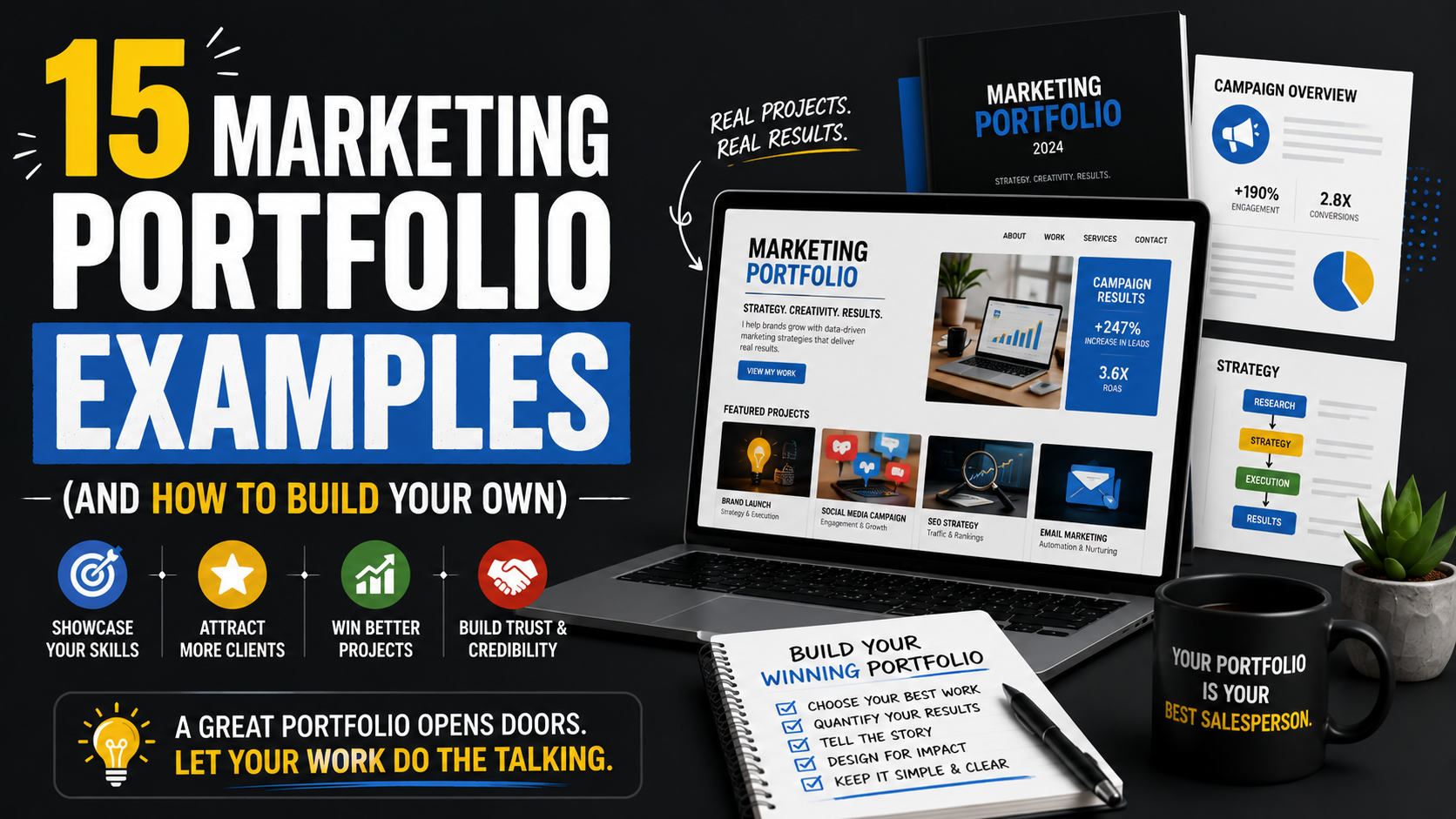
When I started repositioning myself as a copywriter and marketer, I hit a wall almost immediately. Every potential client asked the same question: “Do you have a portfolio?” And for a while, my honest answer was no. I had experience running my own business, writing my own ad copy, and building my own sales pages, but nothing packaged in a way a stranger could quickly look at and trust. But the moment I built a simple portfolio around real examples, everything changed. Conversations moved faster. Clients stopped asking me to “prove” myself and started asking when I could start.
If you’re trying to land marketing or copywriting clients and don’t know what to actually put in your portfolio, this article walks you through 15 real portfolio examples you can build, even if you’re starting with zero paid client work.
What Is a Marketing Portfolio?
A marketing portfolio is a curated collection of your best work that demonstrates your skills, thinking, and results to potential clients or employers. Unlike a resume, which lists what you’ve done, a portfolio shows exactly how you think and what you’re capable of producing.
A strong portfolio answers one question before a client even messages you: can this person actually do the work I need? It removes doubt before the conversation starts, which is exactly what changed things for me once I finally built one.
Here’s something important beginners often miss. A portfolio doesn’t require paid client work to exist. Every example below can be created using a spec project — a self-initiated piece built specifically to demonstrate a skill, using a real or fictional brand as your subject.
15 Marketing Portfolio Examples
1. A Sales Page Sample
One of the strongest pieces you can include is a full sales page written for a real or fictional product. Pick something simple — a digital product, a course, or even a physical item — and write a complete page: headline, pain points, benefits, testimonials section, and a call to action.
This shows a client you understand persuasive structure from start to finish, not just isolated sentences.
2. A Facebook or Instagram Ad Set
Create three to five ad variations for a single product, each testing a different angle — one emotional, one logical, one curiosity-driven. Label each one clearly with the angle it’s testing.
This demonstrates you understand A/B testing and copy variation, which is exactly what businesses running paid ads need help with.
3. An Email Welcome Sequence
Write a five-email welcome sequence for a fictional brand, taking a new subscriber from “just signed up” to “ready to buy.” Include subject lines for each email.
This shows you understand email marketing and nurturing, not just single standalone messages.
4. A Product Description Set
Write five to ten product descriptions for a single niche — skincare, electronics, fashion, anything. Vary the tone slightly between them to show range.
Read, What Is Product Marketing? How to Launch a Product People Actually Want
This is one of the fastest portfolio pieces to build and directly applies to ecommerce clients, exactly like my own watch and jewelry business needed constantly.
5. A Brand Voice Guide
Create a simple one-page document defining a fictional brand’s tone, personality, and sample phrases they would and wouldn’t use. Include three sample social captions written in that voice.
This shows a deeper, more strategic skill — understanding brand consistency, not just writing individual pieces.
6. A Case Study (Even From Your Own Work)
If you’ve run any campaign — even for your own business — write it up as a case study. What was the problem, what did you do, what happened. Include real numbers if you have them.
I used my own ad campaigns for this exact purpose. Even a campaign that didn’t go perfectly can become a case study if you show what you learned and adjusted.
7. A Landing Page Mockup
Design a simple landing page layout (using Canva or a free website builder) for a fictional product launch. Include headline, subheadline, benefits section, and a clear call to action.
This shows you understand how copy and design work together, which is valuable even if you’re not a designer yourself.
8. A Social Media Content Calendar
Build a two-week content calendar for a fictional brand, including post types, captions, and posting times. Show variety — educational posts, promotional posts, and engagement posts.
This demonstrates planning and strategic thinking, not just individual creative pieces.
9. A Blog Article Sample
Write one full SEO blog article on a topic relevant to a niche you want to work in. Include a clear structure — introduction, subheadings, and a conclusion.
This is one of the most versatile portfolio pieces since so many businesses need consistent blog content.
10. A Video Script
Write a short video script — 60 to 90 seconds — for a product explainer or social media ad. Include suggested visuals alongside the narration.
With short-form video dominating almost every platform, this piece signals you can adapt to where marketing is actually heading.
11. A Rebranding Concept
Take an existing brand (with a note that it’s a personal exercise, not official work) and propose a rebrand — new tagline, new tone, new visual direction summary. Explain your reasoning.
This shows strategic thinking at a level beyond just writing — it shows you understand positioning.
12. A Competitor Analysis
Pick a niche and analyze three competing businesses — their messaging, their pricing, their apparent target audience. Summarize the gap you’d exploit if you were marketing a business in that same space.
This piece is particularly powerful for clients specifically because it shows research skill, not just writing skill.
13. A Lead Magnet
Create a simple lead magnet — a one-page checklist, a short guide, or a mini template — for a fictional business in a niche you want to target. Include the accompanying opt-in page copy.
This demonstrates you understand the top of the marketing funnel, not just the sales-focused bottom.
14. A Client Testimonial Request Sequence
Write a short sequence of messages a business could send to request a review or testimonial after a purchase. Include the initial ask, a gentle follow-up, and a thank-you message.
This is a small but often overlooked piece that shows you understand the full customer journey, including what happens after the sale.
15. A Metrics-Based Campaign Summary
If you have any campaign data — even from your own business — create a one-page visual summary showing key numbers: cost per click, conversion rate, return on ad spend. Include a short written takeaway.
Read, What Is Marketing Automation? How to Sell While You Sleep
This is one of the strongest pieces you can include because it shows you think in terms of results, not just creative output — something I only started doing myself after learning the hard way what happens when you run ads without tracking anything.
How Many Portfolio Pieces Do You Actually Need?
You don’t need all 15 to start. Five to seven strong, varied pieces are enough to launch a portfolio that gets responses. Prioritize variety over volume — a sales page, an email sequence, a set of ad variations, a case study, and a blog article already demonstrates range across multiple marketing skills.
Where to Host Your Portfolio
You don’t need an expensive website to start. A simple, clean option works just as well:
A Notion page — free, easy to organize, easy to update.
A Google Drive folder — simple, shareable, no design skill required.
A personal website page — more polished if you already have one, like your own blog.
Canva — useful specifically for design-based portfolio pieces like landing page mockups.
The platform matters far less than the clarity and quality of what’s inside it.
Common Portfolio Mistakes to Avoid
Including too much generic content. A portfolio full of unrelated pieces with no clear niche focus makes it harder for a client to picture you solving their specific problem.
Never updating it. Your portfolio should grow every time you complete real client work. Replace weaker early pieces as stronger, real examples become available.
No context or explanation. Don’t just paste a piece of copy with no framing. Briefly explain the goal, the audience, and the reasoning behind your choices — this shows strategic thinking, not just writing ability.
Overwhelming length. A portfolio isn’t meant to showcase everything you’ve ever written. Curate your strongest examples, not your complete archive.
No clear call to action. End your portfolio with a simple way to contact you. Don’t make an interested client hunt for how to reach you.
How I Built Mine
When I repositioned myself around copywriting and content, I didn’t wait for client work to prove myself. I pulled directly from my own business — product descriptions I had genuinely written for my watch and jewelry brand, ad copy variations I had tested with real budgets, and a case study built from my own campaign data, including the mistakes.
That last part mattered more than I expected. Clients don’t just want to see success — they want to see that you understand why something worked or didn’t, because that’s the thinking they’re actually hiring.
Frequently Asked Questions
Can I build a portfolio without any real client experience?
Yes. Every example in this article can be created as a spec piece using a fictional or existing brand as your subject, clearly labeled as a personal exercise rather than official client work.
Should my portfolio focus on one niche or show variety?
A mix works best when starting out — enough variety to show range, but with a slight lean toward the niche you actually want to attract clients in.
How often should I update my portfolio?
Review it every few months, and replace your weakest pieces as soon as you have stronger, real work to swap in.
Do I need a professional website for my portfolio?
No. A well-organized Notion page or Google Drive folder works perfectly well, especially when you’re just starting out.
Leave a Reply