
A client reached out to me recently, overwhelmed about their ecommerce store. They wanted help with social media marketing, email marketing, sales funnel improvements, and shop optimisation — all at once. My honest response surprised them: that’s too many things at once.
From my experience running my own watch and jewellery brand, focusing on one area at a time gives you significantly more clarity about what is actually happening with your store. When this client told me they had traffic but no sales, I immediately knew where to look first, not at adding more marketing channels, but at what was happening on the page itself once a visitor arrived.
If you are facing the same issues as the client and your ecommerce store has traffic but is not converting, here are the 10 most likely reasons based on real client analysis, not generic theory.
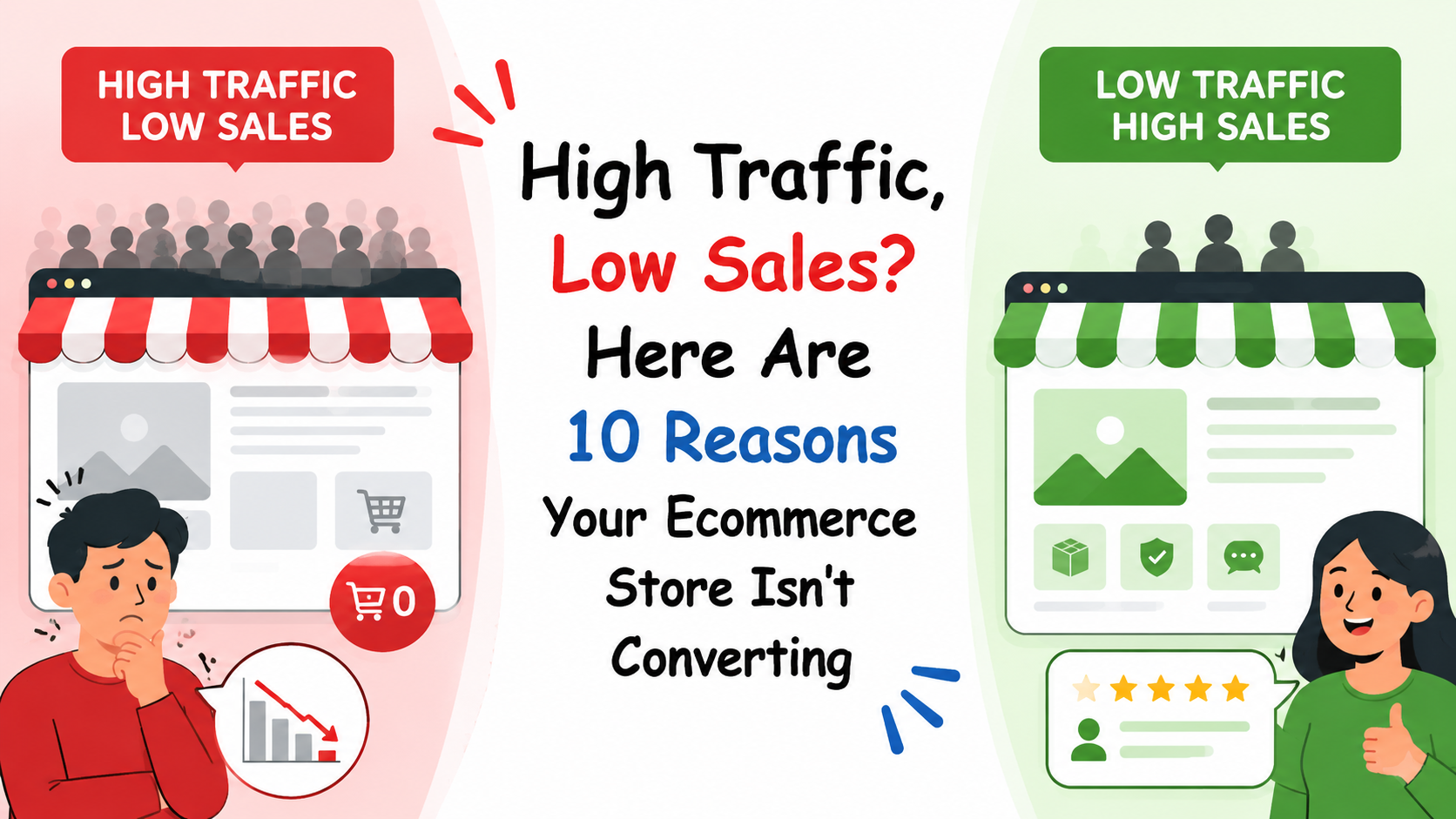
High Traffic, Low Sales? 10 Reasons Your Ecommerce Store Isn’t Converting
1. Your Sales Page Copy Is Not Customer-Centric
This is almost always the first place I look. Most underperforming sales pages describe the product from the seller’s perspective, like materials, dimensions, and technical specifications, without ever translating that into what the customer actually gains.
A watch description that says “stainless steel case, 42mm diameter, sapphire crystal glass” tells the buyer nothing about why they should care. Compare that to “the kind of watch that makes people ask where you got it without paying luxury brand prices.”
Fix it: Rewrite every product description around the outcome the buyer experiences, not the specification list. Ask yourself after every sentence, “Does this tell the customer what they get, or just what the product has?. I covered how to write a sales copy that converts here.
2. Your Call to Action Is Weak or Hidden
Many stores bury their “Add to Cart” or “Buy Now” button below excessive text, or use vague language like “Submit” instead of action-oriented phrases.
Fix it: Make your call to action button visually distinct from the rest of your page using a contrasting colour. Use direct language like “Add to Cart,” “Buy Now,” “Get Yours Today”, and repeat it at multiple points on longer product pages, especially after key benefit sections.
3. Your Product Images Are Not Building Trust
Customers cannot touch, hold, or try your product before buying, as your images are doing all of that work. Low-quality, poorly lit, or single-angle product photos create hesitation rather than confidence.
Fix it: Show your product from multiple angles, in use, and at scale next to a recognisable object so the customer understands true size. If possible, include lifestyle images showing real context, not just a plain white background shot. If you have a video, it is better. Include it but make sure the video resolution is of high quality.
4. Your Pricing Lacks Context
This was specifically flagged in my client conversation. Pricing without context creates hesitation. A $150 watch with no comparison point makes the customer wonder whether it is overpriced or a steal. A $150 watch positioned next to “comparable luxury brands charge $800 for similar craftsmanship” gives the price meaning.
Fix it: Anchor your price against a relevant comparison, highlight any value stack (bonuses, warranty, free shipping), and consider showing a “was/now” price if you are running a genuine promotion.
5. Your Traffic Quality Does Not Match Buyer Intent
As I told my client, if you have traffic but no sales, you have to ask where that traffic is coming from and why it is clicking. Some products naturally attract curiosity clicks. That is people who click because something looks interesting on a feed, not because they have any real intention to buy.
Read, How to Use Local Influencer Partnerships to Drive Sales (Step-by-Step Guide)
Fix it: Review your ad targeting and creative. If your ad copy or image promises something slightly different from what your sales page delivers, you are attracting the wrong mindset of visitor. Align your ad messaging precisely with your sales page promise so the traffic arriving is already pre-qualified to want what you are selling.
6. Your Landing Page Loads Too Slowly
Page speed is one of the most overlooked conversion killers in ecommerce. Research consistently shows that a significant percentage of visitors abandon a page if it takes more than three seconds to load, and on mobile, where most ecommerce traffic now originates, slow load times are even more punishing to conversion rates.
Fix it: Compress your images, remove unnecessary apps or scripts from your Shopify theme, and test your store speed using Google’s PageSpeed Insights tool. Every second of delay directly costs you sales.
7. Your Landing Page Design Lacks Clarity
This connects directly to what I told my client. When a customer lands on your page, is your offer immediately clear? If a visitor has to scroll and read multiple paragraphs before understanding what they are looking at and why it matters to them, you have already lost a significant percentage of that traffic.
Fix it: Your headline and hero image should communicate the core offer within the first three seconds. Remove clutter, competing messages, and unnecessary navigation distractions on product pages designed to convert from ad traffic. I covered how to design a landing page that turns visitors into buyers here.
8. Your Pixel and Tracking Setup Is Misconfigured
If you are running paid advertising, your Facebook Pixel or equivalent tracking setup can answer most of the questions about where your funnel is breaking down, but only if it is configured correctly. A misconfigured pixel can show you inflated traffic numbers while hiding the real story about where visitors are dropping off.
Fix it: Verify that your pixel is firing correctly at each funnel stage like page view, add to cart, and purchase. Use Meta’s Events Manager to confirm each event is tracking accurately before drawing any conclusions about your traffic quality.
9. Your Product Type Naturally Has Lower Purchase Intent
Some products are simply more prone to attracting browsing behaviour rather than immediate buying intent. Highly visual, novelty, or impulse-category products often generate strong engagement and clicks without translating proportionally into sales, because the initial interaction is curiosity-driven rather than need-driven.
Fix it: If you suspect this is happening, study your add-to-cart rate versus your purchase rate separately. A high add-to-cart rate with low completed purchases suggests interest exists but something at checkout like price, trust, or shipping cost is causing hesitation at the final step.
10. You Are Trying to Fix Too Many Things at Once
This was the core message I gave my client, and it deserves to be the final point here. When a store owner tries to simultaneously improve social media marketing, launch email campaigns, redesign the sales funnel, and optimise the shop all at once, it becomes almost impossible to know which change actually caused any improvement or decline in performance.
Fix it: Start with one variable. Analyse your existing traffic and sales page first, since that is where you have the most existing data to learn from. Make one focused change, measure the impact for a defined period, then move to the next area. Email marketing and additional acquisition channels come later, after your existing traffic is converting at a healthy rate.
How to Diagnose Your Specific Conversion Problem
Before changing anything, gather this data first:
- Add-to-cart rate: what percentage of visitors add a product to their cart
- Cart abandonment rate: what percentage of those add-to-carts never complete checkout
- Bounce rate on product pages: how many visitors leave without any interaction
- Traffic source breakdown: which channels are sending visitors, and how those visitors behave differently by source
These four numbers alone will usually tell you whether your problem is happening at the top of the funnel (wrong traffic), the middle (unclear or unconvincing page), or the bottom (checkout friction or pricing hesitation).
Frequently Asked Questions
Should I focus on getting more traffic or fixing my conversion rate first?
Fix conversion first. More traffic sent to a page that is not converting simply multiplies the same problem at a higher cost. Once your existing traffic converts at a healthy rate, scaling traffic becomes significantly more profitable.
What is considered a good ecommerce conversion rate?
Generally, 2 to 3 percent is considered an average baseline for ecommerce stores, with strong stores reaching 4 to 5 percent or higher depending on the product category and price point. If you are well below 2 percent with consistent traffic, the issues outlined in this article are worth investigating immediately.
How long should I test one change before moving to the next?
For paid traffic, allow at least 5 to 7 days and a meaningful sample size of visitors before judging whether a change improved performance. For organic traffic changes, give it 2 to 4 weeks since the sample size builds more slowly.
If you want to learn how to build and market profitable online businesses using AI tools — including sales pages, ad campaigns, and digital products? Get the AI Hustle eBook on Selar.
Leave a Reply