
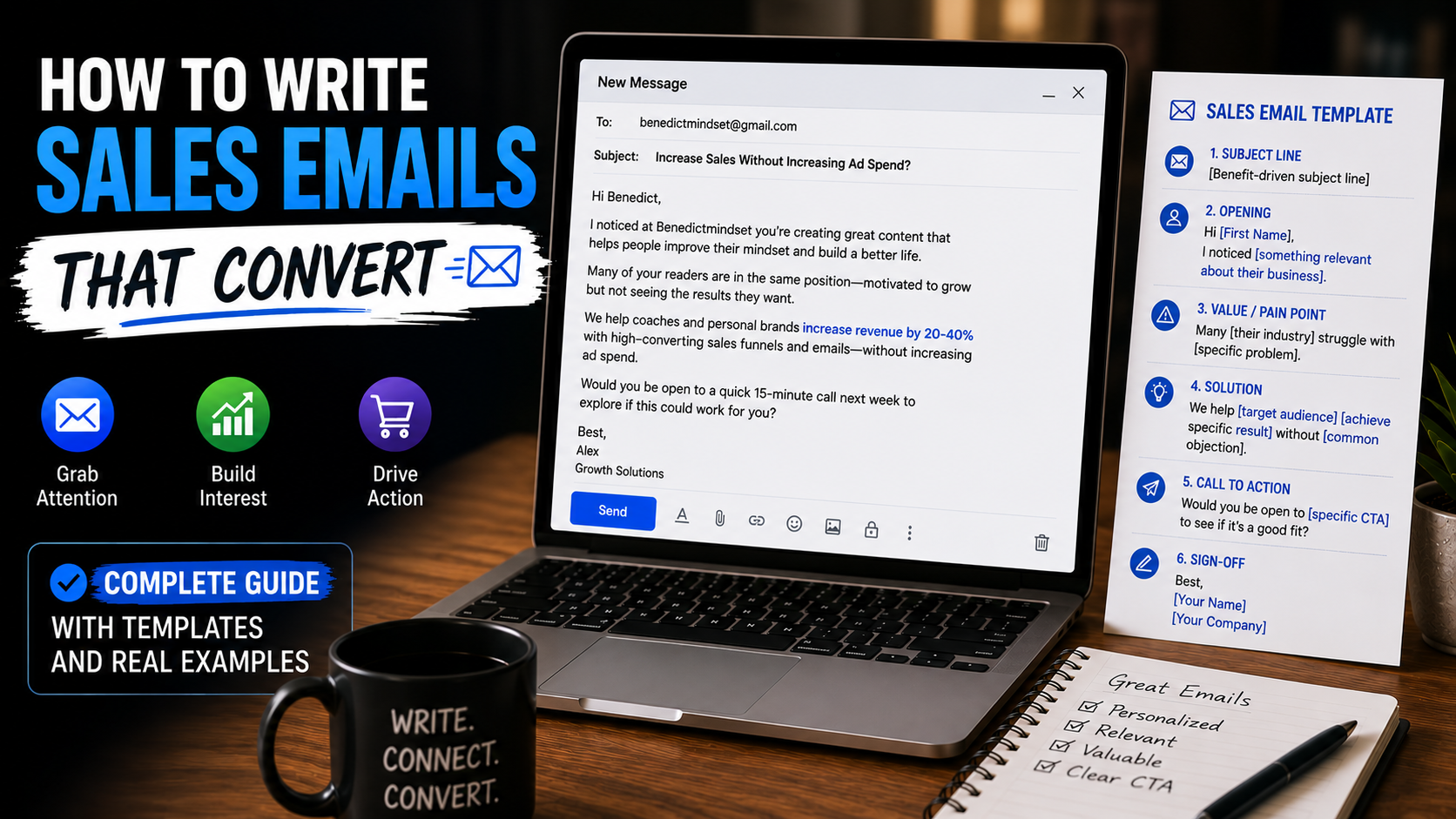
In January 2026, an international client hired me to help launch an online course with no existing audience and a tight budget for paid ads. With the numbers not working for a premium-priced course on ads alone, we built an email list from scratch using a free lead magnet. Over six weeks, that list converted into more than 50 sales.
The course sold out its first cohort almost entirely through email. No expensive ad spend. No viral social media moment. Just a sequence of well-written sales emails sent to a list of people who had opted in because they wanted exactly what we were offering.
That experience reinforced something I already believed but had never proven at that scale: email marketing remains one of the highest-converting channels available to any business or creator, precisely because the audience already chose to hear from you. In this article, we are going to look into how to write emails that get opened, read, and converted into sales. Let’s get started.
What Is Email Marketing?
Email marketing is the practice of sending targeted messages to a list of subscribers who have given permission to receive communication from you, with the goal of building relationships, providing value, and ultimately driving sales.
Unlike social media, where your message competes with hundreds of other posts in an algorithm-controlled feed, email lands directly in someone’s inbox. You own the relationship. No algorithm decides whether your subscriber sees your message. They either open it or they do not, based entirely on how compelling your subject line is and how much they trust you.
This is why experienced marketers consistently say “the money is in the list.” A list of 1,000 genuinely engaged email subscribers will almost always outperform 10,000 passive social media followers in actual sales generated.
Types of Email Marketing (With Examples)
1. Welcome Sequences
The first series of emails a new subscriber receives after joining your list. Keep it typically three to five emails introducing yourself, delivering on the promise that got them to sign up, and warming them toward your paid offer.
Example: A new subscriber downloads a free “AI Income Checklist” and receives a welcome email that delivers the checklist, followed by emails sharing your story, addressing common objections, and eventually presenting your paid eBook.
2. Promotional or Sales Emails
These are direct emails focused on selling a specific product or service, typically sent during a launch period or as part of an ongoing promotional calendar.
3. Newsletter Emails
They are regular value-driven emails like tips, insights, and updates that are sent on a consistent schedule to maintain engagement and trust between sales pushes.
4. Abandoned Cart Emails
Automated emails sent to someone who added a product to their cart but did not complete the purchase, typically offering a gentle reminder or small incentive to complete the transaction.
5. Re-Engagement Emails
Sent to subscribers who have stopped opening your emails. It is designed to win back their attention or clean inactive subscribers from your list.
Now, for the course launch I mentioned, we used a combination of welcome sequence emails to build trust, followed by a focused promotional sequence during the actual launch week.
How to Write Emails That Get Opened, Read, and Convert to Sales
Step 1: Write a subject line that creates curiosity or urgency
Your subject line is the single most important factor determining whether your email gets opened at all. Generic subject lines like “Newsletter #12” or “Check out our new product” get ignored.
Strong subject lines either create curiosity (“The mistake costing you sales every single day”), speak directly to a benefit (“How to double your output without working more hours”), or use personalization and specificity (“Sarah, your spot closes in 24 hours”).
Step 2: Open with a hook, not a greeting
From my interaction with people, one thing I have observed is that many amateur emails waste the first line on “I hope this email finds you well”, a sentence that adds nothing and gives the reader permission to stop reading. Open instead with something that immediately continues the curiosity from your subject line.
Step 3: Write like you are talking to one person
The best-converting sales emails read like a personal message from a friend, not a corporate announcement to a crowd. Use “you” frequently. Write in a conversational tone. Avoid stiff, formal business language.
Read, What Is a Landing Page? How to Build Pages That Turn Visitors Into Buyers (With Real Examples)
Step 4: Keep your paragraphs short
Email is read primarily on mobile devices, and long paragraphs feel exhausting in a small inbox window. So, break your thoughts into one or two sentences per paragraph with generous spacing between them.
Step 5: Lead with the reader’s problem, not your product
Before mentioning what you are selling, acknowledge the specific frustration or desire your reader is currently experiencing. This builds the emotional foundation that makes your offer feel like the obvious next step rather than an interruption.
Step 6: Include one clear call to action
Just like a sales page, an email should have a single, clear next step. Do not ask the reader to “check out our website, follow us on Instagram, and reply to this email” all in the same message. Pick one action and repeat it once or twice within the email.
Step 7: Use a P.S. line
Studies on email engagement consistently show the P.S. line is among the most-read parts of any email. Many readers scan to the bottom before deciding whether to read the full message. Use it to reinforce your call to action or add a final compelling reason to act.
With that in mind, let’s look at some email marketing templates.
Email Marketing Templates
Template 1: The Welcome Email
Subject: Here’s your [lead magnet name] 🎉
Hi [Name],
Thanks for downloading [lead magnet]. You now have everything you need to get started.
Quick question: what’s the biggest challenge you’re facing with [topic] right now? Hit reply and let me know. I read every response personally.
Talk soon,
[Your name]
Template 2: The Story-Based Sales Email
Subject: The morning everything changed for me
[Name],
A year ago, I [relatable personal struggle related to your offer].
I tried [common solution], but nothing changed.
Then I discovered [your method/product], and within [specific timeframe], [specific result].
I built [product name] to show you exactly how to do the same thing.
[Call to action button: Get Started Today]
Template 3: The Direct Promotional Email
Subject: This closes Friday
[Name],
Just a quick reminder, [product name] closes for enrolment this Friday at midnight.
Here’s what’s inside:
✅ [Benefit 1]
✅ [Benefit 2]
✅ [Benefit 3]
[Call to action button: Enroll Now]
See you inside,
[Your name]
Template 4: The Objection-Handling Email
Subject: “But I don’t have time for this…”
[Name],
I hear this a lot. “I want to start, but I just don’t have the time right now.”
Here’s the truth: [reframe the objection with a specific counterpoint].
[Brief example or testimonial supporting this point]
You don’t need more time. You need the right system. That’s exactly what [product] gives you.
[Call to action button]
Template 5: The Final Urgency Email
Subject: Last chance (closes tonight)
[Name],
This is it, [product name] closes tonight at midnight and the price goes up after that.
If you’ve been on the fence, here’s what you need to know: [one final compelling reason].
[Call to action button: Get Instant Access Before Midnight]
P.S. [Final reassurance or guarantee statement]
Real Email Examples That Convert
From the course launch I worked on in January 2026, here is a simplified version of the subject line sequence that performed best:
- Email 1: “Your free guide is here”: 58% open rate
- Email 2: “The #1 mistake beginners make”: 51% open rate
- Email 3: “Why most courses don’t work (and what we did differently)”: 47% open rate
- Email 4: “Doors open today”: 49% open rate
- Email 5: “12 hours left”: 44% open rate, highest click-through rate of the sequence
The pattern here is clear. Subject lines that promise specific value or create genuine urgency consistently outperformed generic announcement-style subject lines throughout the entire sequence.
Why Email Tracking Tools Matter
While sending email is important, it is also crucial to track the performance because you cannot improve what you do not measure. Email tracking tools that are built into platforms like Mailchimp, Brevo, ConvertKit, and Beehiiv show you exactly how your emails are performing.
Open rate tells you whether your subject lines are working. A low open rate means you need to test new subject line approaches.
Click-through rate tells you whether your email content and call to action are compelling enough to make readers take action.
Conversion rate tells you whether the email ultimately led to a sale, which is the metric that matters most for revenue.
Without tracking these numbers, you are writing emails blind, repeating the same mistakes without knowing what is actually working. And for the course launch I did in January, tracking data showed us in real time which subject lines and angles were resonating, allowing us to adjust the remaining emails in the sequence before the doors closed.
The Do’s and Don’ts of Outbound Sales Emails
Do personalize beyond just the first name. Reference something specific about the recipient’s business, situation, or previous interaction whenever possible.
Do keep your first outbound email short. Cold outbound emails should be under 150 words. Long emails to someone who does not know you yet feel presumptuous and reduce response rates.
Do follow up. Most replies to outbound sales emails come from the second, third, or even fourth message in a sequence and not the first.
Don’t attach large files in your first email. Attachments trigger spam filters and create friction. Use links instead.
Don’t use excessive exclamation points or all-caps text. This signals spam to both email providers and human readers.
Don’t buy email lists. Sending email to purchased lists damages your sender reputation, violates most email platform terms of service, and produces extremely poor results compared to organically built lists.
Don’t ignore mobile formatting. Test every email on a phone screen before sending because most recipients will open it there first.
How to Follow Up on Sales Emails
Following up is where most beginners give up too early and where most actual sales happen. Now, here is the pattern I use;
First follow-up: 2 to 3 days later
A brief, friendly check-in: “Just floating this back to the top of your inbox in case it got buried. Any questions I can answer?”
Second follow-up: 5 to 7 days later
Add new value or a different angle: “Thought this might be helpful. Here’s a quick example of how [product] helped someone in a similar situation to yours.”
Final follow-up: 10 to 14 days later
A polite close: “I don’t want to keep filling your inbox, so this will be my last note on this. If now isn’t the right time, no worries at all. Feel free to reach out whenever it makes sense for you.”
This final message often generates responses precisely because it removes pressure. Readers respond well to permission to say no.
Frequently Asked Questions
How often should I send sales emails to my list?
For regular newsletter content, once or twice weekly maintains engagement without overwhelming subscribers. During an active launch or promotional period, daily emails for five to seven days are standard practice and typically do not hurt open rates if the content remains valuable and relevant.
What email marketing platform should I use as a beginner?
Mailchimp and Brevo both offer generous free plans for beginners with small lists. As your list grows past a few thousand subscribers, ConvertKit and Beehiiv offer more advanced automation and segmentation features suited for serious email marketers.
How do I build an email list from scratch?
Offer something valuable for free, such as a checklist, a guide, or a discount, in exchange for an email address. Promote this lead magnet across your blog, social media, and Pinterest. Every visitor who opts in becomes a warm lead you can nurture toward a future sale.
Now, if you want to learn how to build complete sales systems — including email marketing, sales pages, and digital products — using AI tools? Get the AI Hustle eBook.
Leave a Reply