
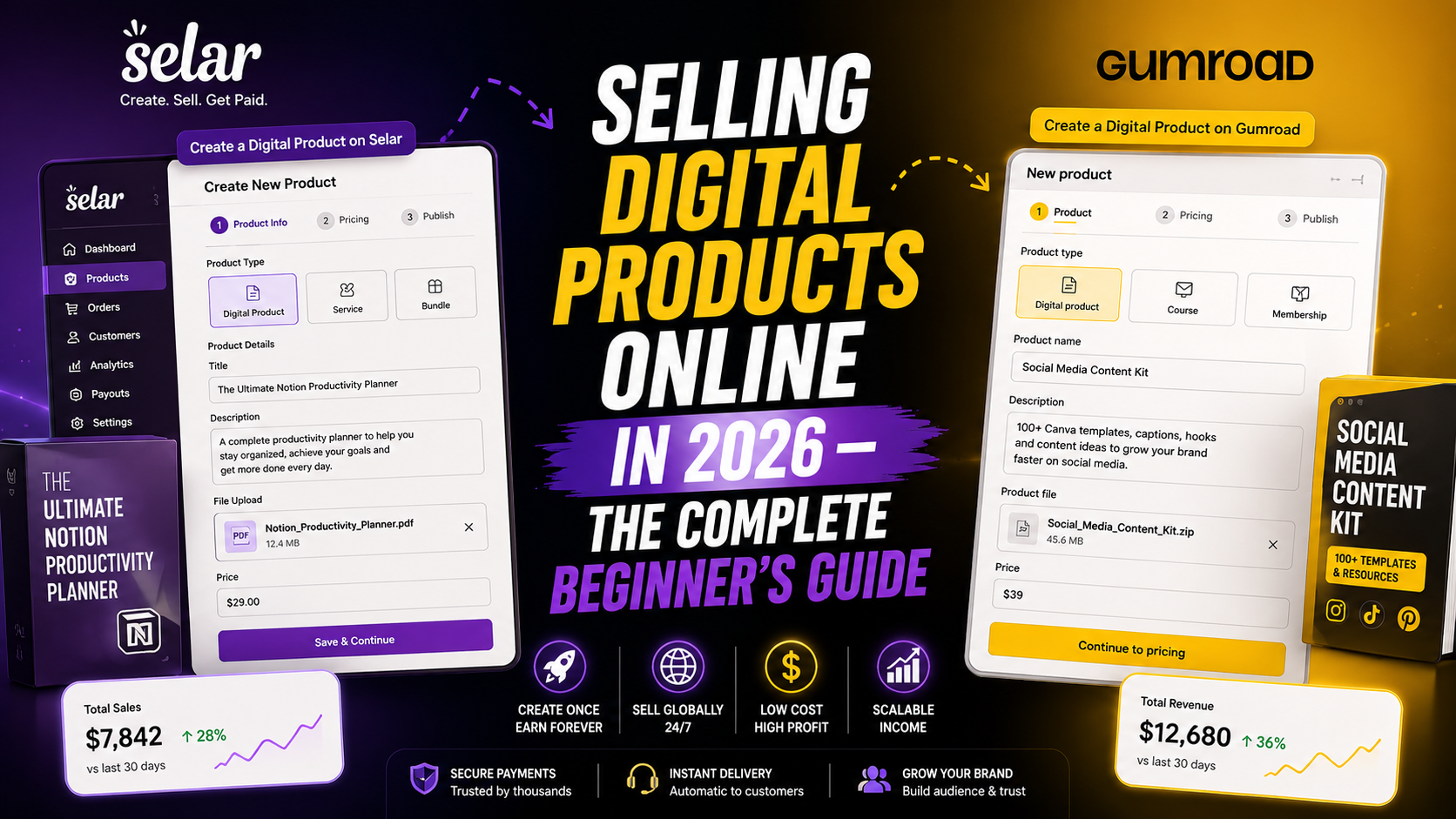
Last year I crossed six figures from selling digital products without holding a single item of inventory, without shipping a single package, and without speaking to most of my buyers directly. The products I created months ago are still selling today, while I focus my time on creating the next one.
This is the real appeal of selling digital products online. You create once and earn repeatedly. If you have knowledge, a skill, or even just the willingness to research a topic thoroughly, you can build a genuine income stream using nothing but free tools and the platforms already covered in this guide.
Here is exactly how I did it and how you can start today.
What Are Digital Products?
A digital product is anything you create once and deliver electronically without any physical inventory, such as eBooks, online courses, Notion templates, prompt packs, stock images, spreadsheets, and software tools. All of these fall into this category. Unlike physical products, there is no manufacturing cost, no shipping logistics, and no risk of unsold stock sitting in storage.
This is what makes digital products one of the most attractive income streams available to anyone starting from zero in 2026. The only real investment required is your time. Now you know what a digital product is, let’s look at how to create and sell a digital product online in 2026.
How To Create and Sell a Digital Product Online in 2026
Step 1: Choose a Profitable Digital Product Idea
Before creating anything, you need to identify what to sell. The biggest mistake beginners make is choosing a topic they personally enjoy rather than one with proven buyer demand.
How to validate your idea:
- Search your topic idea on social media like Facebook, Instagram and Reddit and study what is already selling. Note the price points, the format, and how many reviews top products have
- Go to Google and search your topic followed by “how to”. A high number of results signals genuine search demand
- Check Facebook, LinkedIn, Twitter, X and Reddit for people actively complaining about or searching for solutions related to your topic idea
- Use ChatGPT to research the top questions people are asking about your chosen topic. These become the foundation of your product content
The strongest digital products solve one specific problem for one specific audience. A broad eBook on “making money online” competes with thousands of similar products. A focused eBook on “how American students can make their first $1000 online using free AI tools” speaks directly to a defined buyer and converts significantly better.
Before choosing a product, ask yourself this question: “Why should someone buy this product instead of just using AI to find the solution?” If the solution to your digital product is easily accessible using AI, then marketing becomes difficult. For example, someone can search “How to make money online using AI” and get results quickly. But someone searching “Why is my Facebook ad cost per lead (CPL) very high” might not be able to get convincing results online.
Step 2: Choose Your Digital Product Type
Different formats suit different goals, skill levels, and time investments.
eBooks: This is the most accessible starting point. You can write using Claude or ChatGPT, design in Canva, and sell on Selar or Gumroad. A solid eBook can be completed and published within one to two weeks.
Prompt packs: Curated collections of tested AI prompts for a specific use case. Fast to create, typically taking one to three days, and increasingly in demand as more people adopt AI tools without knowing how to use them effectively.
Notion templates: Pre-built productivity systems for content calendars, client trackers, or goal planning. Requires comfort with Notion but very little design skill beyond clear structure.
Online courses: Higher-ticket products that take longer to create but command premium pricing. Best suited to topics where you have genuine depth of knowledge and can teach step by step.
Stock images and design assets: Generated using AI image tools like Midjourney or Adobe Firefly, packaged into themed bundles and sold to content creators and businesses.
Now, for your first digital product, I recommend starting with an eBook or a prompt pack as both have the fastest path from idea to first sale.
Step 3: Create Your Digital Product Using AI
This is where AI tools dramatically compress the time between idea and finished product.
For eBooks:
Use ChatGPT to research your topic and identify the key questions your audience needs answered. Use Claude to write each chapter, working section by section rather than asking for the entire book in one prompt. This produces noticeably better, more detailed output. Review every section critically and add your own knowledge, local examples, and specific details that make the content feel genuinely useful rather than generic. Avoid generic AI outputs without human input.
For prompt packs:
Test 30 to 50 prompts thoroughly for your specific use case before packaging them. A prompt pack is only valuable if every prompt inside it genuinely works. So, test each one multiple times to confirm consistent results.
For templates:
Use Claude to help you structure the logic of your template clearly. Build it in Notion or Google Sheets, then write clear instructions so buyers understand exactly how to use it without confusion.
Now, once your content is finished, design your cover and any interior visuals using Canva, generating custom images with ChatGPT’s image generator or Adobe Firefly where needed.
Step 4: Choose Where to Sell Your Digital Product
Selar — the strongest platform for African buyers. Supports local payments in many African countries like Ghana, Kenya, South Africa, Nigeria, etc. It also supports 24-hour payouts. This is where the majority of my own digital product sales come from.
Gumroad — best for reaching international buyers paying in dollars. Clean checkout experience and strong buyer trust globally.
Amazon KDP — specifically for books, both fiction and non-fiction, with access to a massive built-in audience actively searching for content to buy.
Etsy — strong for templates, planners, and design-focused digital products with a buyer base that actively searches for downloadable products.
I personally use Selar for my African audience and Gumroad simultaneously for international buyers. Running both gives you access to two completely different markets from the same product.
Step 5: Write a Sales Page That Converts
Your sales page is doing the entire job of convincing a stranger to buy without you ever speaking to them. Structure it using these elements:
A specific, benefit-driven headline that states the outcome the buyer gets, not just what the product contains
A short opening paragraph identifying the buyer’s exact problem before introducing your product as the solution
Bullet point benefits: Three to five outcomes the buyer will experience, written in plain, specific language
Social proof: Even one genuine testimonial significantly increases buyer confidence
A clear, repeated call to action: “Get Instant Access Now” performs better than a generic “Buy Now” button
If you want a deeper breakdown of sales page writing, I have covered this extensively in a separate guide on this blog. The same principles that sell a $300 product apply to a $5 digital product, just with less depth required.
Read, How to Write a Sales Page That Converts — Complete Guide With 8 Real Examples
Step 6: Price Your Digital Product Strategically
Pricing in the African market requires a different approach than pricing for international buyers. You can convert these pricing guides to your local currency.
| Product Type | Naira Price Range | Dollar Price Range |
|---|---|---|
| Short guide or checklist | ₦1,500 to ₦3,000 | $3 to $7 |
| Standard eBook | ₦3,000 to ₦7,500 | $7 to $20 |
| Prompt pack | ₦2,000 to ₦5,000 | $5 to $15 |
| Notion template | ₦2,500 to ₦8,000 | $5 to $20 |
| Online course | ₦10,000 to ₦50,000 | $20 to $100 |
Now, for your first product, price at the lower end of your category to encourage faster initial sales and reviews. Once you have social proof, gradually increase your price. Buyers trust products with reviews significantly more than identical products with none.
Step 7: Drive Traffic to Your Digital Product
A perfectly created product with zero traffic generates zero sales. Here is where the consistent income actually comes from.
Facebook and Instagram ads: The fastest way to generate initial sales and validate that your product converts. Start with a small daily budget of ₦2,000 ($5) to ₦3,000 ($10) and scale once you confirm profitability.
Pinterest: Long-term, compounding traffic. A single well-designed pin can continue driving buyers to your product for years after you post it. Create an account on Pinterest. Then create a board and create a pin for your digital product. Use an image that captures attention on your pin.
A blog: Write SEO-optimised articles related to your product’s topic that naturally lead readers toward your sales page as the deeper resource. A very good landing page converts better than a normal Selar or Gumroad sales page. Especially for high-ticket products, you need a good landing page to convince people to buy.
Read, What Is a Landing Page? How to Build Pages That Turn Visitors Into Buyers (With Real Examples)
Your own social media pages: Post consistently about the problem your product solves, building an audience that trusts you before you ever ask them to buy.
Email list: Every buyer’s email becomes a warm lead for your next product. Collect emails from day one, and you build a compounding asset alongside your product sales.
I personally rely on a combination of Facebook ads for immediate sales and a growing blog and Pinterest presence for long-term, free traffic that compounds month after month.
Step 8: Collect Reviews and Build Social Proof
After every sale, follow up directly and ask for a review. Most buyers are happy to leave one if you ask at the right moment. The right time is immediately after they have experienced genuine value from your product, likely 3 to 5 days after the purchase.
Reviews do more than build trust on your sales page. They directly improve your conversion rate for every future visitor who lands on that page. A product with five genuine reviews consistently outsells an identical product with zero reviews, regardless of price.
Step 9: Turn One Product Into Multiple Income Streams
Once your first digital product is generating consistent sales, expand strategically rather than randomly.
Create a related second product that naturally complements the first. Buyers who trust you once are significantly more likely to buy again.
Build a bundle that combines your existing products at a discounted total price to increase your average transaction value.
Use your existing buyers as your warmest audience for every future launch. Email them first before spending a single dollar on advertising a new product.
This is exactly how my own income grew from one eBook to a full catalogue of digital products generating six figures in combined dollar revenue. Not from one viral moment, but from consistently building on what already worked.
Common Mistakes to Avoid
Creating a digital product before validating demand: The single most expensive mistake. Always confirm people are searching for and buying similar products before investing time in creation.
Pricing your digital product too low out of fear: Underpricing signals low quality and trains your audience to expect discounts permanently.
Neglecting the sales page: A brilliant product with weak sales copy will consistently underperform a mediocre product with a genuinely persuasive page.
Stopping promotion too early: Most digital product creators give up on promotion right when momentum is about to build. Consistency in traffic generation matters more than any single viral post.
Frequently Asked Questions
How much money do I need to start selling digital products online?
Realistically, zero. Claude, ChatGPT, and Canva all have free plans sufficient to create your first product, and Selar offers free account setup with no upfront cost. Your only investment is time until you choose to scale with paid advertising.
How long does it take to make your first sale?
With a focused product and even a small $5 daily ad budget, most beginners see their first sale within the first one to two weeks. Organic traffic through blogging and Pinterest typically takes longer — often two to three months before meaningful sales volume builds.
Can I sell digital products without a website?
Yes. Both Selar and Gumroad provide complete sales pages and checkout systems on their own platforms, meaning you can launch and sell without owning any website or domain at all.
Want the complete step-by-step guide to building multiple online income streams using AI — including digital products, freelancing, and Amazon KDP? Get the AI Hustle eBook on Selar or Gumroad.
Leave a Reply