
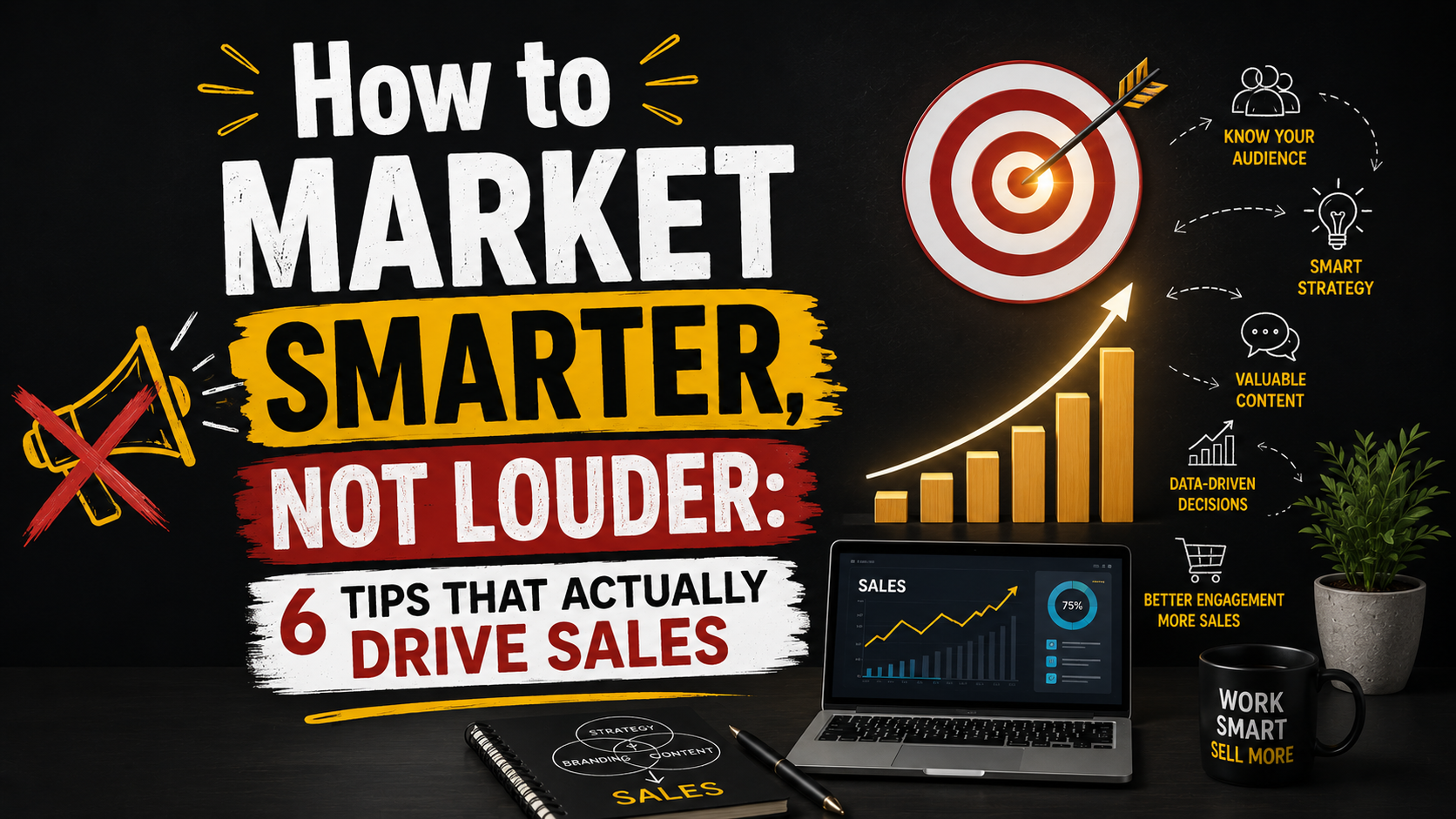
A single marketing mistake cost me thousands. I spent money trying to reach everyone, broad targeting, generic messaging, ads designed to appeal to as many people as possible. The result? Lots of impressions, almost no sales. I learned the hard way that marketing louder is not the same as marketing smarter.
Once I shifted how I thought about marketing strategy for my watch and jewelry business, everything changed. Not because I spent more, but because I finally understood who I was actually talking to and why they would care. In this article, I will walk you through the 6 lessons that fixed it.
6 Tips That Actually Drive Sales
1. Stop Marketing to Everyone: Market to the Smallest Viable Audience
Here is the question you are probably asking yourself right now: isn’t reaching more people always better? I thought so too, until I saw my own ad results prove otherwise.
When you try to speak to everyone, you end up speaking clearly to no one.
Niche marketing, which is narrowing your message to the smallest group of people who genuinely need what you sell, makes those specific people feel like you are talking directly to them, not at a crowd.
For my watch business, I stopped advertising to “people who like accessories” and started speaking directly to professionals who wanted to look successful without paying luxury prices. The audience got smaller. The conversion rate did not.
How to apply this: Define exactly who needs your product most, not who might like it, but who genuinely needs it. Speak to that person specifically in every ad, post, and product description.
2. Give Value First: Sales Will Follow Naturally
You might be wondering: if I give away value for free, won’t people just take it and never buy? In my experience, the opposite happens. The more you genuinely help people before asking for a sale, the more they trust you enough to buy when you finally do ask.
Content marketing built on real education and insight, not just promotional posts, builds the kind of trust that makes selling feel unnecessary, because people already want to buy from you by the time you make the offer.
I started sharing genuine tips about watch care, how to spot quality craftsmanship, and styling advice content with zero direct selling. Sales actually increased because customers felt like I genuinely knew what I was talking about before they ever clicked “buy.”
How to apply this: Before every promotional post, ask yourself, “Have I given this audience something useful recently? If the answer is no, post value first.
3. Be Consistent: Say the Right Thing, Then Say It Everywhere
Here is something I learned slowly and expensively: saying the right thing once is not enough.
Brand consistency, which is repeating your core message across every platform and touchpoint, is what separates businesses people trust from businesses that just blend into the noise.
You might think repeating yourself sounds boring or repetitive. It does not feel that way to your audience. Most people need to see your message multiple times, across multiple places, before it actually registers and builds trust.
Read, How to Close Sales Deals Faster Without Being Pushy — A Practical Guide
For my business, this meant my Instagram captions, my WhatsApp broadcast messages, and my website all needed to say a consistent version of the same core promise: quality watches at honest prices, backed by a real guarantee. Once everything aligned, customers started repeating that exact message back to me in their own words.
How to apply this: Write down your one core brand message in a single sentence. Check every platform you post on and ask yourself, “Is that same message clearly present everywhere, or does it shift depending on where someone finds you?
4. Talk About Your Customer, Not Yourself
This one stung a little when I first realized it. I used to post constantly about my brand, our story, our values, our craftsmanship. And even with that constant posting, engagement was still weak. But the moment I shifted to talking directly about my customer’s needs, goals, and challenges instead, everything changed.
People generally ignore brands that talk endlessly about themselves. They engage with brands that talk about them, their problems, their goals, what they are trying to achieve.
How to apply this: Before posting anything, ask yourself, “Does this talk about what I want my customer to know, or does it talk about what my customer actually needs to hear right now? Shift every post toward their world, not yours.
This is one of the simplest marketing tips available, and also one of the most consistently ignored.
5. Win the Heart First: Facts Only Justify the Decision
You might assume people make buying decisions logically by comparing prices, reading specifications, and weighing pros and cons. In reality, most buying decisions are emotional, and logic only shows up afterward to justify a decision someone already made in their heart.
When I sold watches, customers rarely bought because of the technical specifications. They bought because of how the watch made them feel confident, put-together, successful. The specifications mattered, but only after the emotional decision had already been made.
How to apply this: Lead your marketing with the feeling your product creates, then follow up with the facts that support that feeling. Feelings drive the click. Facts close the sale.
This single shift is one of the most overlooked sales psychology principles in small business marketing.
6. Make It Personal, or It Will Be Ignored
Here is a question worth sitting with: when was the last time a generic message actually made you buy something? Probably never. Generic messages get scrolled past without a second thought. Personal messages create genuine connection, and connection is what actually drives action.
This does not mean every message needs your customer’s name in it. It means your message needs to speak directly to their specific world, their specific frustration, their specific goal, rather than a broad, one-size-fits-all statement that could apply to literally anyone.
For my watch business, switching from “quality watches for everyone” to “the watch that makes people ask where you got it” made an enormous difference, because it spoke directly to a specific feeling my exact customer wanted.
How to apply this: Read your last five marketing posts. Could they apply to absolutely any business in any industry? If yes, they are too generic. Rewrite them to speak to one specific person’s specific situation.
Why “Louder” Marketing Stopped Working for Me
Looking back at the mistake that cost me thousands, the core problem was never my budget; it was my approach. I was shouting the same generic message to as many people as possible, hoping volume alone would produce sales. Smarter marketing does not require a bigger budget. It requires a clearer understanding of exactly who you are talking to and exactly what they need to hear.
Once I applied these six shifts to my own business, my advertising spend did not increase, but my results did, because every dollar was finally speaking to the right person, with the right message, in a way that actually felt personal to them.
How to Start Applying These 6 Marketing Tips Today
You do not need to overhaul your entire marketing strategy overnight. Pick one of these six lessons and apply it this week. If you are unsure where to start, begin with number one by narrowing your audience. Everything else on this list becomes significantly easier once you know exactly who you are talking to.
I made the expensive mistake of trying to fix all of this at once, which mostly created confusion rather than clarity. Start small. Apply one principle. Measure the difference. Then move to the next.
Frequently Asked Questions
Does marketing to a smaller audience really increase sales?
Yes, in most cases. A smaller, well-defined audience that genuinely needs your product converts at a significantly higher rate than a broad audience with mixed or weak interest, even though the total reach is smaller.
How do I know if my marketing message is too generic?
If your message could realistically apply to almost any business in any industry without changes, it is too generic. Strong marketing speaks directly to one specific audience’s specific situation.
Should I focus on emotional appeal or factual information in my marketing?
Lead with emotion to capture attention and desire, then follow with facts to justify the decision your audience has already started making emotionally. Both matter, but emotion typically drives the initial click and interest.
Follow me on Facebook, X (formerly Twitter), and YouTube
Leave a Reply