
When I started marketing my watch and jewelry business online, I did everything manually, like writing every ad by hand, designing every graphic from scratch, guessing which audience to target, and hoping something would work. It was slow, expensive, and most of it failed.
Today, almost every part of that process runs faster and performs better because of AI tools and the difference in results is not small. Campaigns that once took me days to build now take hours, and they convert better because the research, copy, and targeting are sharper than anything I produced alone.
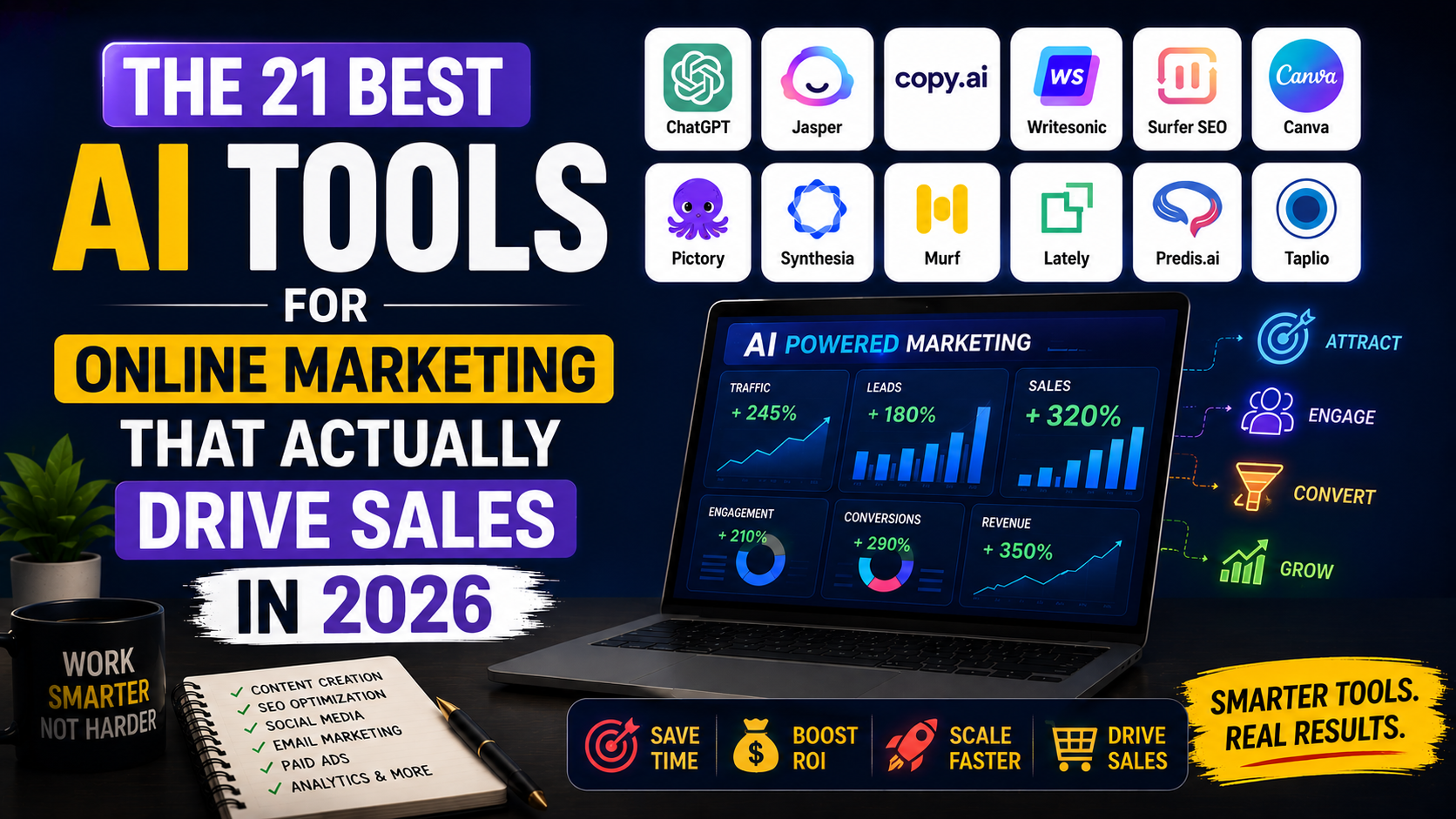
If you are marketing anything online, such as a product, a service, a digital download, or your own personal brand, this article covers the 21 AI tools for online marketing that will genuinely help you to drive sales in your business, plus exactly how to start if you are completely new to online marketing.
What Is Online Marketing?
Online marketing, also called digital marketing, is the practice of promoting products or services through internet channels: social media, search engines, email, websites, and paid advertising. Unlike traditional marketing, where you rent a billboard and hope the right people drive past it, online marketing lets you place your message directly in front of the specific people most likely to buy.
These several core channels are as follows:
- Social media marketing, which allows you to promote your business and services through Facebook, Instagram, TikTok, X, and LinkedIn
- Search engine optimisation (SEO) which ranks your website content on Google so buyers find you organically
- Paid advertising, which involves running targeted ads on platforms like Meta and Google
- Email marketing, which is nurturing and converting an audience through their inbox
- Content marketing, which is building trust through blogs, videos, and valuable free content
When I ran my watch business, online marketing was the entire engine. Every sale I made came from one of these channels, and every failed campaign taught me which parts of the process needed better tools.
Online Marketing vs Affiliate Marketing — What Is the Difference?
These two terms confuse a lot of beginners, so let me clear it up simply.
Online marketing is the broad skill of promoting anything through internet channels. It is the umbrella.
Affiliate marketing is one specific business model under that umbrella, like promoting other people’s products and earning a commission on every sale made through your unique link.
Here is the practical difference: when I marketed my own watches online, I kept 100 percent of every sale, but I also carried all the costs, like inventory, ads, delivery, and customer service. An affiliate marketer promoting someone else’s watches would earn maybe 5 to 20 percent commission per sale, but with zero inventory, zero delivery headaches, and zero product risk.
Neither is better universally. Online marketing for your own products builds a real asset and higher margins. Affiliate marketing is a lower-risk entry point that teaches you marketing skills without needing your own product. Many people, like myself, end up doing both: marketing their own products while earning affiliate income from the tools they already use and recommend.
The good news? Every AI tool on this list works for both.
How to Start Online Marketing (Even With No Experience)
Before the tools, here is the honest starting sequence I wish someone had given me:
1. Pick one product and one audience. Do not try to market everything to everyone. My results only improved when I stopped targeting “people who like accessories” and focused on one specific buyer.
2. Choose one primary channel. Facebook and Instagram for visual products, Google and SEO for search-driven services, and email for nurturing existing audiences. Master one before adding another.
3. Learn the basics of your chosen channel. Free resources cover the fundamentals like how ads work, how the algorithm distributes content, and what a landing page needs.
Read, 100 AI Income Ideas You Can Start Today: From Side Hustles to Full Businesses
4. Use AI tools to execute faster. This is where the list below comes in. The tools do not replace your strategy. They multiply your speed and quality once you have one.
5. Track everything and adjust. Marketing is a feedback loop. The people who win are not the most creative; rather, they are the ones who measure, learn, and adjust fastest.
Now, let’s look at the major AI tools you need for online marketing.
The 21 Best AI Tools for Online Marketing That Actually Drive Sales in 2026
1. Claude: Best for Marketing Copy That Converts
Every sales page, ad copy, and product description I produce starts in Claude. Of every AI writing tool I have tested, Claude produces the most naturally human-sounding marketing copy, which matters enormously because copy that sounds robotic kills trust and conversions.
Use it for: Sales pages, ad copy, email campaigns, product descriptions
Free plan: Yes
Why it drives sales: Persuasive, natural copy is the single highest-leverage asset in online marketing. It is the difference between traffic that browses and traffic that buys.
2. ChatGPT: Best for Marketing Research and Ideas
ChatGPT is my research engine. Before writing any campaign, I use it to analyse my audience, brainstorm angles, and identify what competitors are doing.
Use it for: Audience research, content ideas, keyword suggestions, campaign brainstorming
Free plan: Yes
Why it drives sales: Better research before a campaign means fewer wasted ad budgets afterward, a lesson I learned the hard way before AI tools were part of my workflow.
3. Canva AI: Best for Marketing Graphics and Ad Creatives
Every ad creative, social media graphic, and product banner for my business runs through Canva. Its AI features like text-to-image generation, background remover, and Magic Write, make professional design accessible to complete beginners.
Use it for: Ad creatives, social media posts, banners, product mockups
Free plan: Yes
Why it drives sales: In visual marketing channels like Instagram and Facebook, the creative determines whether anyone stops scrolling at all.
4. Meta Ads AI (Advantage+): Best for Automated Ad Targeting
Meta’s built-in AI, Advantage+, automatically optimises who sees your ads based on who is actually converting. When I stopped micromanaging my audience targeting and let the system optimise toward purchases, my cost per sale dropped noticeably.
Use it for: Facebook and Instagram ad campaign optimisation
Free plan: Built into Meta Ads Manager (you pay for the ads, not the AI)
Why it drives sales: It finds buyers you would never have manually targeted.
5. Google Gemini: Best for Data, Trends, and Chart Creation
Google Gemini connects directly to Google’s live search data, making it the strongest tool for spotting current trends and generating data visuals for marketing content.
Use it for: Trend research, data charts for content, market analysis
Free plan: Yes
Why it drives sales: Marketing built on current trends consistently outperforms marketing built on guesses.
6. Surfer SEO: Best for Ranking Content on Google
If SEO is part of your strategy, Surfer SEO analyses top-ranking pages for any keyword and shows you exactly what your content needs to compete, like word count, keywords, and structure.
Use it for: Blog content optimisation, keyword strategy
Free plan: No — paid plans only
Why it drives sales: Organic Google traffic is the most sustainable, lowest-cost buyer source online. Every article that ranks becomes a permanent salesperson.
7. Mailchimp AI: Best for Email Marketing Automation
Mailchimp’s AI features help write subject lines, optimise send times, and segment audiences automatically, turning email from a manual chore into an automated sales channel.
Read, How to Market Smarter, Not Louder: 6 Tips That Actually Drive Sales
Use it for: Email campaigns, welcome sequences, audience segmentation
Free plan: Yes — up to 500 contacts
Why it drives sales: Email consistently delivers the highest return on investment of any online marketing channel.
8. ManyChat: Best for Chat Marketing and Automated Selling
ManyChat builds automated conversations on WhatsApp, Instagram, and Facebook Messenger, answering customer questions and guiding them to purchase even while you sleep. For a business like mine, where customers asked the same questions repeatedly before buying, this category of tool solves a genuinely painful problem.
Use it for: Automated customer replies, chat-based sales funnels
Free plan: Yes — up to 1,000 contacts
Why it drives sales: Fast responses close sales. Slow responses lose them. Automation makes every response instant.
9. ElevenLabs: Best for Video and Audio Marketing Content
Video marketing converts powerfully, and ElevenLabs produces realistic AI voiceovers that let you create professional video ads and content without recording anything yourself.
Use it for: Video ad voiceovers, faceless video content, audio marketing
Free plan: Yes — 10,000 credits monthly
Why it drives sales: Video ads consistently outperform static images on social platforms, and voiceover quality directly affects how professional your brand feels.
10. Perplexity: Best for Fact-Checked Market Research
Before making any claim in marketing content, I verify it with Perplexity, which provides sourced, cited answers rather than confident guesses.
Use it for: Competitor research, statistic verification, market analysis
Free plan: Yes
Why it drives sales: Credibility sells. One false claim discovered by a customer damages trust permanently.
11. Buffer: Best for Social Media Scheduling and Consistency
Buffer lets you batch-create a week of social content in one session and schedule it to publish automatically at optimal times.
Use it for: Social media scheduling, posting consistency, engagement analytics
Free plan: Yes — 3 channels
Why it drives sales: Consistency builds the audience trust that converts followers into buyers, and automation makes consistency achievable for one person running everything.
12. Hotjar: Best for Understanding Why Visitors Don’t Buy
Hotjar shows you heatmaps and recordings of how real visitors behave on your website, like where they click, where they hesitate, and where they leave. When my own landing page was getting traffic but no conversions, this category of insight is exactly what revealed the problem.
Use it for: Landing page optimisation, conversion analysis
Free plan: Yes — basic plan available
Why it drives sales: You cannot fix a leaking funnel you cannot see. Watching real visitor behaviour turns guesswork into precise fixes.
13. Jasper: Best for Brand-Consistent Marketing Campaigns
Jasper is built specifically for marketing teams, with over 50 templates covering ad copy, product descriptions, and campaign content. Its standout feature is Brand Voice. It learns your brand’s tone and keeps every piece of content consistent across campaigns.
Use it for: Ad copy at scale, brand-consistent campaigns, marketing templates
Free plan: 7-day trial only — paid from $49/month
Why it drives sales: Consistent brand messaging across every touchpoint builds the recognition and trust that turns repeat impressions into purchases.
14. Copy.ai: Best for Fast Short-Form Marketing Copy
Copy.ai generates multiple variations of short-form copy like headlines, social captions, product descriptions, and email subject lines in seconds. When you need ten headline options to split-test rather than one perfect draft, this is the fastest tool for the job.
Use it for: Headline variations, social media captions, A/B testing copy
Free plan: Yes — limited monthly credits
Why it drives sales: Split testing multiple headline variations consistently improves click-through rates, and Copy.ai makes generating those variations effortless.
15. Writesonic: Best for SEO-Optimised Marketing Content
Writesonic combines AI writing with built-in SEO optimisation, generating blog articles and landing page copy already structured around your target keywords with direct integration into Google Search Console for tracking performance.
Use it for: SEO blog content, landing page copy, keyword-optimised articles
Free plan: Yes — limited generation credits
Why it drives sales: Content that ranks on Google brings in buyers continuously without ongoing ad spend. It is one of the most sustainable traffic sources in online marketing.
16. Pictory: Best for Turning Text Into Marketing Videos
Pictory converts blog articles, scripts, or long text into short marketing videos automatically, matching your words with stock footage, captions, and music. For marketers without editing skills, it removes the biggest barrier to video content entirely.
Use it for: Turning blog posts into videos, social media video content, video ads
Free plan: Free trial available — paid from $19/month
Why it drives sales: Video content earns significantly more engagement and reach than static posts on nearly every social platform, and Pictory makes video production accessible to non-editors.
17. Synthesia: Best for AI Presenter Marketing Videos
Synthesia creates professional videos featuring realistic AI avatars that speak your script — no camera, no studio, no presenter required. It is widely used for product explainers, marketing presentations, and multilingual campaign videos across 140+ languages.
Use it for: Product explainer videos, presenter-style marketing content, multilingual video campaigns
Free plan: Limited free plan — paid from $18/month
Why it drives sales: A human face explaining your product builds trust faster than text alone, and Synthesia delivers that without the cost of filming.
18. Murf: Best for Professional Voiceovers on a Budget
Murf generates natural-sounding AI voiceovers across 120+ voices and 20+ languages, with fine control over pitch, speed, and emphasis. It is a strong alternative to ElevenLabs for marketers producing video ads and explainer content at volume.
Use it for: Video ad voiceovers, explainer narration, multilingual audio content
Free plan: Yes — limited minutes
Why it drives sales: Professional audio quality directly shapes how credible your brand sounds, and buyers trust brands that sound polished.
19. Lately: Best for Turning Long Content Into Social Posts
Lately uses AI to break long-form content like blogs, videos, and podcasts into dozens of ready-to-publish social media posts, learning over time which messaging styles generate the most engagement for your specific audience.
Use it for: Repurposing long content, social post generation, engagement optimisation
Free plan: Free trial available — paid plans required after
Why it drives sales: One blog article becomes thirty social posts, multiplying your reach from every piece of content you create. That’s the exact repurposing system that keeps marketing consistent without burning out.
20. Predis.ai: Best for AI-Generated Social Media Ads
Predis.ai generates complete social media posts and ad creatives like visuals, captions, and hashtags together from a simple text description of your product. It also analyses competitor content to show you what is working in your niche.
Use it for: Complete ad creative generation, competitor analysis, social content at scale
Free plan: Yes — limited monthly posts
Why it drives sales: It produces ready-to-run ad creatives in minutes, letting you test more creative variations, and more testing consistently leads to finding the winning ads that scale.
21. Taplio: Best for LinkedIn Marketing and Personal Branding
Taplio is built specifically for growing on LinkedIn, generating post ideas, writing content in your voice, scheduling at optimal times, and identifying high-value accounts to engage with. For marketers targeting professionals and B2B buyers, LinkedIn is the highest-value platform, and Taplio automates the consistency it demands.
Use it for: LinkedIn content creation, personal branding, B2B audience growth
Free plan: Free trial available — paid from $39/month
Why it drives sales: LinkedIn buyers are the highest-intent professional audience online, and consistent visibility there generates inbound client enquiries that no cold outreach can match.
How to Combine These Tools Into One Marketing System
You do not need all twelve tools on day one. Here is the practical starter stack I recommend:
Research with ChatGPT and Perplexity → Write with Claude → Design with Canva AI → Distribute through Meta Ads and Buffer → Convert with ManyChat and optimised landing pages → Measure with Hotjar and adjust.
That single loop: research, create, distribute, convert, measure is the entire engine of online marketing. The AI tools simply make every stage faster and sharper than doing it manually, which is exactly the difference between my early struggling campaigns and the systems I run today.
Frequently Asked Questions
Do I need to pay for AI marketing tools as a beginner?
No. Ten of the twelve tools on this list have genuinely useful free plans. Start free, prove your marketing works, then upgrade only the tools directly generating revenue.
Which AI tool should I start with if I can only pick one?
Claude or ChatGPT. Marketing lives and dies on words — your ads, your product descriptions, your emails. A strong AI writing tool improves every other channel you eventually add.
Can AI tools replace learning marketing skills?
No, and this matters. AI tools multiply the effectiveness of someone who understands their audience and offer. They cannot fix a campaign targeting the wrong people with the wrong message. Learn the fundamentals; let AI handle the execution speed.
Want the complete step-by-step guide to building online income using these exact AI tools — from marketing to digital products to freelancing? Get my AI Hustle eBook.
Leave a Reply