
I ran an ad recently and got 45 leads. Real people, genuinely interested, messaging me about my mini-importation book. I felt like I’d cracked something. Then I sent every single one of them straight to my Selar link and asked them to buy.
But guess what? I got zero sales. Not one. Forty-five people who showed clear interest, and I lost every single one of them, because I skipped the part where I actually explain the offer, build a little trust, and let them decide with confidence. I sent a link. I didn’t build a relationship. And that mistake taught me more about selling than any campaign that actually worked.
If you’ve ever had plenty of interest and almost no sales to show for it, this article is for you.
First, let’s talk about what’s actually happening inside a buyer’s mind before they ever click “pay.”
What Is the Buyer’s Journey?
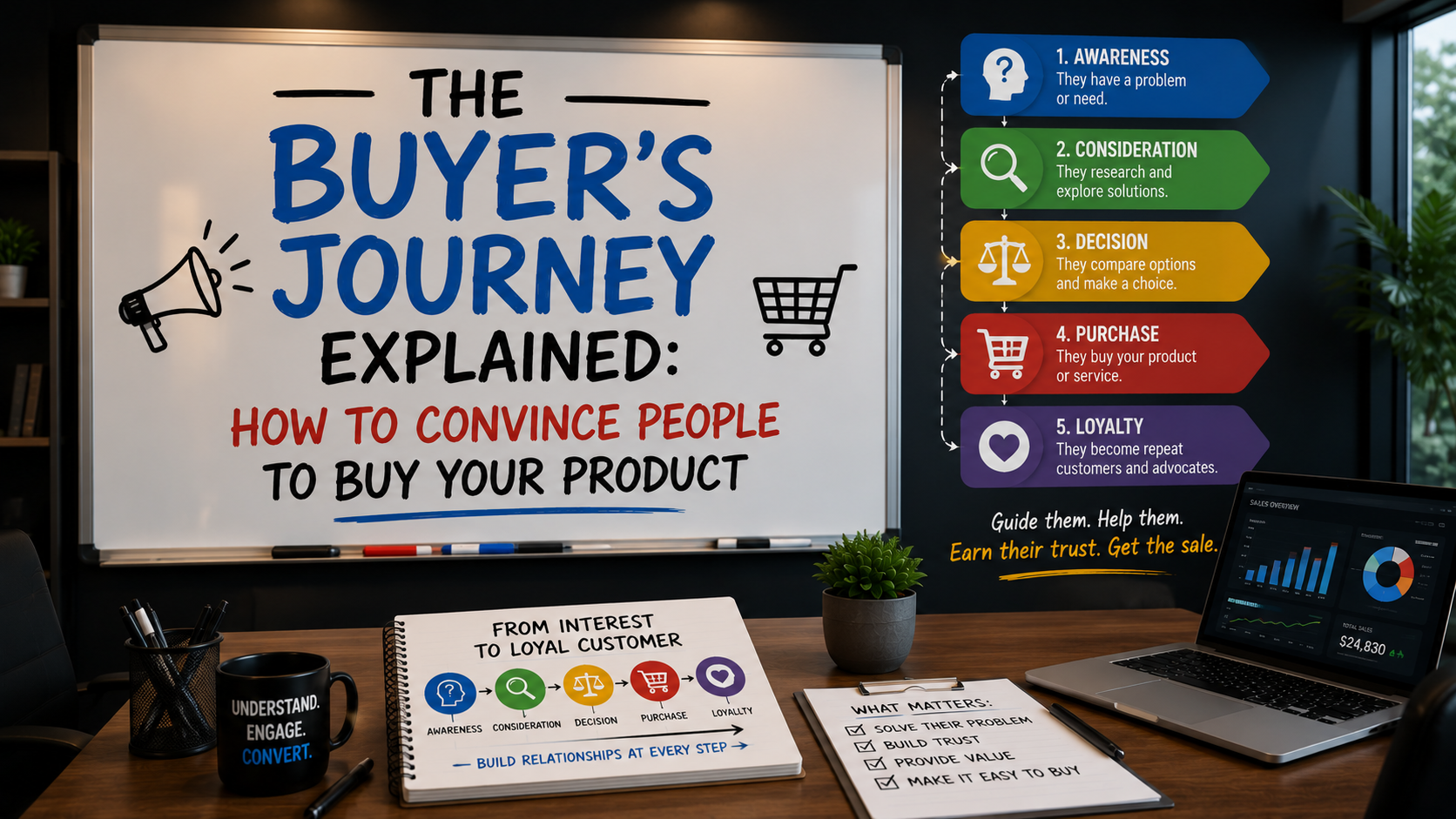
The buyer’s journey is the path someone takes from first noticing a problem to actually deciding to pay for a solution. Most marketing frameworks break it into three stages: awareness (they realize they have a problem), consideration (they start comparing possible solutions), and decision (they choose one and buy).
Here’s what I didn’t understand before my 45-leads disaster. When someone messages you about your product, they are usually still somewhere between awareness and consideration. They are genuinely curious, but nowhere near ready to decide. I treated every single one of them as if they were already at the decision stage, ready to click and pay. They weren’t. I skipped two entire stages of their actual journey, and the silence I got back was the direct result.
Why a Link Alone Never Closes a Sale
Sending someone a payment link the moment they show interest assumes they’ve already made up their mind. In reality, the decision stage is where doubt is loudest, not quietest. This is exactly where people need reassurance, not just access to a checkout page.
I learned this the hard way. Those 45 people weren’t rejecting my product. They were being asked to decide before they’d been given a real reason to trust me. Let me walk you through what actually needs to happen before someone genuinely decides to buy.
The Buyer’s Journey Explained: How To Convince People to Buy Your Product
Give Them a Clear Offer
Before anything else, your offer needs to be instantly understandable. Not “check out my product”, but exactly what it is, who it’s for, and what it solves.
When I finally slowed down and explained my book clearly —what’s inside, who it’s for, and what specific problem it solves—instead of just dropping a link, conversations changed completely. A confused prospect never buys. Clarity has to come before persuasion.
Show Proof — Testimonials and Personal Experience
People don’t trust claims. They trust evidence. This is one of the clearest, most consistent findings across how buyers actually evaluate a decision. They lean on reviews, testimonials, and other people’s experiences far more than they lean on a seller’s own words.
For me, this meant leading with my own story, like the scams I survived and the hundreds of goods I’ve since imported successfully. Real experience, told honestly, does more convincing than any polished sales line ever could. If you have customer testimonials, use them. If you don’t yet, your own documented experience is proof too.
Your Sales Page Has to Be Genuinely Convincing
A link with no context is not a sales page. A real sales page answers the questions a hesitant buyer is silently asking: what is this, why should I trust you, what happens if it doesn’t work for me, and what do I do next.
This is exactly why my 45 leads went nowhere. There was no page doing any of that convincing work. There was just a link, and a link cannot answer a single doubt in someone’s mind.
Competitive, Clear Pricing
Price only becomes an objection when the value hasn’t been made clear yet. But once your offer and proof are solid, your price still needs to feel fair relative to what else is available. Research your market. Know what similar products charge. A price that feels wildly out of step with the market creates hesitation, no matter how good your offer actually is.
Demonstrate the Product Actually Works
If you’re selling a physical product, this matters even more. People need to see it functioning, not just described. A video, a demonstration, a before-and-after — anything that proves the product does what you say it does. Claims alone rarely move a buyer at the decision stage. Seeing it work does.
Offer a Guarantee
A guarantee removes the single biggest fear standing between interest and payment: what if this doesn’t work for me, and I’ve lost my money for nothing?
Read, 15 Marketing Metrics That Actually Matter (And How to Track Them)
Even a simple, honest guarantee like a refund window, or a promise to help personally if something goes wrong, shifts the risk off the buyer and onto you. That shift alone moves a lot of hesitant “maybe” responses into a real yes.
Discounts and Urgency, Used Honestly
Sometimes a genuine discount or a real deadline does move someone from consideration into decision. But this only works if it’s honest. A fake countdown or a “discount” that never actually expires trains people to stop trusting your urgency altogether. Use scarcity only when it’s real.
Your Appearance and First Impression Matter More Than You Think
This one is easy to underestimate. How you present yourself, your profile, your tone in that very first message. How good your page looks shapes trust before a single word of your pitch is read. A sloppy first impression makes even a great offer feel less credible.
When I finally cleaned up how I opened conversations by starting with a warm, clear first message instead of jumping straight to a sales pitch, the entire tone of the conversation shifted. People respond to how a conversation begins, not just what’s being sold.
The Quality of Your Ad Sets the Tone Before You Even Speak
The ad itself is often someone’s very first touchpoint with you — their entry into the awareness stage. If the ad feels cheap, confusing, or overly aggressive, that impression follows the person into every conversation afterward. A clear, well-made ad doesn’t just generate clicks. It sets the emotional tone for everything that follows.
Packaging Matters, Even for Digital Products
People genuinely respond to good packaging — a clean sales page, a professional-looking cover, a well-organized message. It signals that you take your own product seriously, which quietly gives buyers permission to take it seriously too. Even after purchasing the product, if the packaging is not attractive, you will get bad reviews.
Recently, I came in contact with a post on Facebook where someone was complaining about how terrible a digital product he bought online was. He thought he could get an ebook that is over 200 pages for such a price but was shocked that the ebook he bought for $20 was barely 20 pages. The surprising thing is that the ebook was being sold by a popular social media influencer. This shows how poor packaging can lead to terrible customer reviews.
Buyers Rarely Move in a Straight Line
Here’s something worth knowing honestly: people don’t move neatly from awareness to consideration to decision in one clean pass. They circle back. They reread your offer. They look at your proof again after already seeing your price. This is completely normal, and it’s exactly why one message with a link was never going to work on my 45 leads. Real decisions take a little back-and-forth, not a single push.
What I Do Differently Now
I no longer treat interest as readiness to buy. When someone messages me now, I slow down. I ask a question. I explain the offer clearly before ever mentioning price. I share real proof like my own story, or a customer’s. I make sure my page and my tone feel trustworthy before I ever ask for the sale.
Read, What Is Marketing Automation? How to Sell While You Sleep
None of this makes selling slower in a way that hurts you. It makes selling actually work, instead of generating interest that quietly disappears the moment you ask for money too soon.
Frequently Asked Questions
How long does the buyer’s journey usually take?
It varies enormously depending on the price and complexity of what you’re selling. A low-cost digital product might move from awareness to decision within a single conversation. A higher-priced offer often takes several touchpoints and more reassurance before someone commits.
What if someone asks a lot of questions but never buys?
This usually means they’re still in the consideration stage, weighing your offer against alternatives or their own doubts. Instead of pushing harder, keep addressing their specific hesitations directly — that’s often what finally moves them into a decision.
Is it wrong to send a direct payment link at all?
Not always — for a buyer who’s already decided, a direct link is exactly what they need. The mistake is assuming everyone who shows interest is already at that stage, which is exactly what cost me those 45 leads.
Leave a Reply