
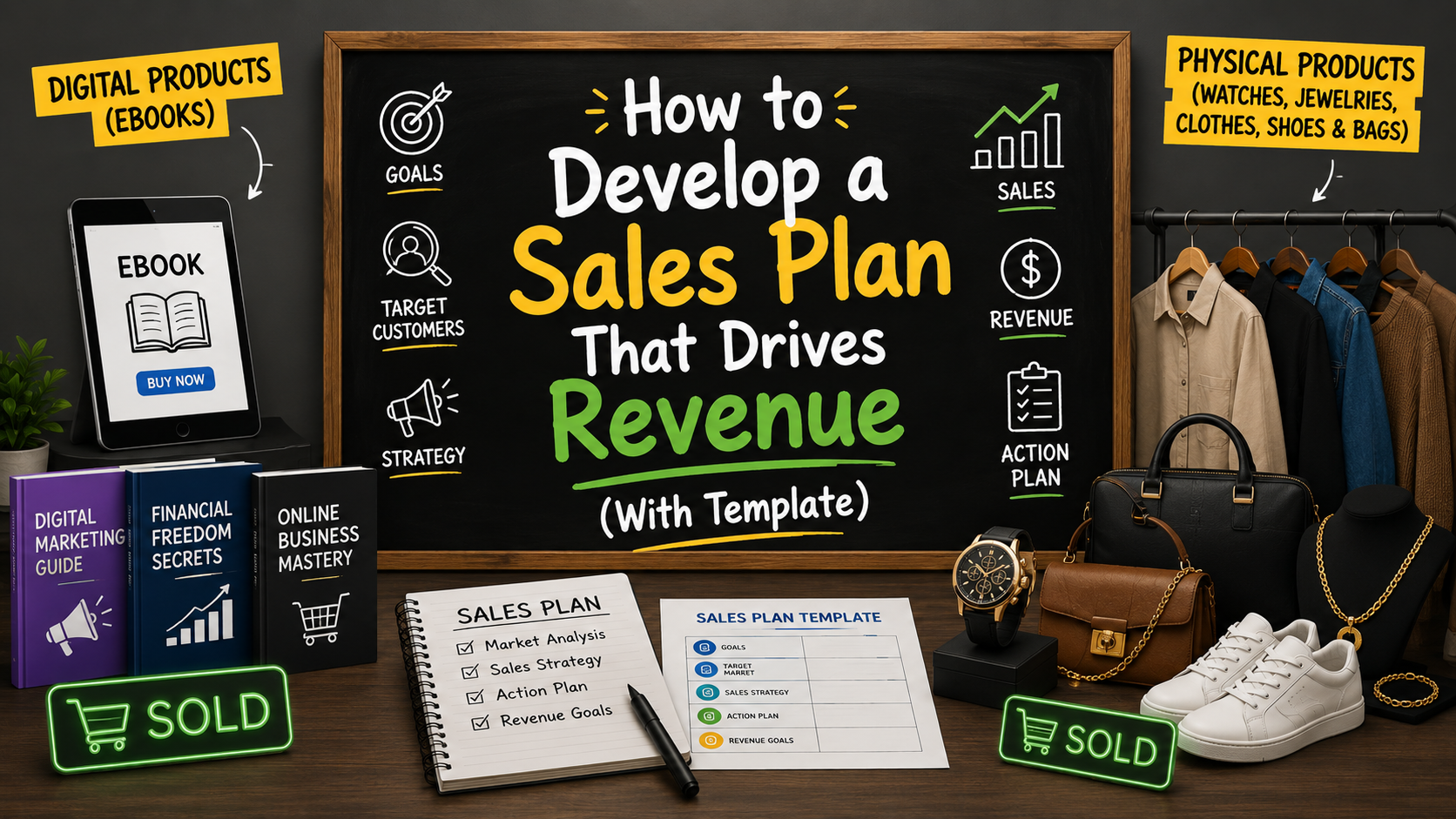
Early this year, I spent hundreds of dollars running Facebook ads with no clear strategy. All I knew was my product, I had a budget, and I assumed that combination was enough. But I later realised it was not. Without a defined target audience, a clear pricing strategy, or a specific monthly sales goal, I was essentially throwing money at strangers and hoping something would stick.
What actually changed my results was building a real sales plan, a structured document that forced me to answer specific questions before spending another dollar on advertising. In this article, I will walk you through exactly how to build one, with a complete template you can use today.
What Is a Sales Plan?
A sales plan is a structured document that outlines exactly who you are selling to, what you are selling, how much you can realistically charge, how many sales you need each month to hit your revenue goals, and the specific actions you will take to reach those numbers. It is the difference between hoping for sales and engineering them deliberately.
Unlike a vague goal like “increase sales this year,” a proper sales plan breaks that ambition down into specific, measurable, and actionable components, exactly what was missing from my own early advertising attempts. Now, how do you build a sales plan that will increase your shop’s revenue?
How to Develop a Sales Plan That Drives Revenue
1. Define Your Target Audience Clearly
Before writing anything else, you need absolute clarity on who you are selling to. Vague targeting like “anyone interested in fashion” or “small business owners” produces vague results.
How to define this properly: Identify age range, location, income level, and the specific problem your product or service solves for them. If you sell watches, your target audience might be “professionals aged 25 to 40 who want to look successful without paying luxury brand prices.” This level of specificity directly informs every other decision in your sales plan.
This step answers one of the most searched questions in business strategy, how to identify your target market for sales planning.
2. Clarify Exactly What You Are Selling
This sounds obvious, but many businesses fail to articulate this with enough precision. Are you selling a single product, a range of products, a service, or a digital product like an eBook or course? Each category requires a different sales approach.
How to apply this: Write a one-sentence description of your core offer that a stranger could understand immediately. “I sell affordable, stylish wristwatches for young professionals” is clearer and more actionable than “I sell accessories.”
This answers the search query how to clearly define your product offering for a sales strategy.
3. Determine What Your Audience Is Willing to Pay
Pricing without research is guessing. Your pricing strategy must be grounded in what your specific target audience can realistically afford and is willing to spend, not just what covers your costs plus a margin.
How to research this: Study competitor pricing in your niche, survey existing customers if you have any, and test different price points with small ad budgets to see which converts best. For my watch brand, understanding that my audience would pay $30 to $50 but hesitated above $100 fundamentally shaped my entire product line.
This directly answers how to price your product based on customer willingness to pay.
4. Set a Specific Monthly Sales Target
A sales plan without a number is not a plan, it is a wish. You need a specific, realistic monthly sales target that you can break down into weekly and even daily actions.
How to calculate this: Start with your revenue goal, divide by your average product price, and you get your required unit sales. If you want to earn $3,000 monthly and your average product sells for $100, you need 30 sales per month which is roughly one sale per day.
This answers the frequently searched question of how to set realistic sales targets for your business.
5. Identify Where Your Improvement Areas Actually Are
When sales are underperforming, most business owners guess at the problem instead of diagnosing it. Your sales plan should include a clear process for identifying whether the issue lies in your offer, your sales page, your pricing, or your traffic quality.
Read, Relationship Selling: How to Build Trust That Turns Prospects Into Buyers
How to diagnose this: Track each stage of your funnel separately. From impressions, clicks, landing page views, and completed purchases. A high click rate with low conversion points to a sales page or pricing problem. Low clicks despite high impressions, points to a weak offer or targeting issue.
This answers how to identify weaknesses in your sales funnel.
6. Develop Your Core Sales Message
Your sales message is the central argument for why someone should buy from you specifically, rather than a competitor or not at all. This message should appear consistently across your ads, sales page, and any customer conversations.
How to craft this: Identify the single biggest benefit your product delivers and the primary objection standing in the way of purchase. Combine both into one clear statement like “Look successful without the luxury price tag and if it doesn’t perform exactly as promised, return it within 14 days.”
This answers the search query how to create a sales message that convinces customers to buy.
7. Plan Your Outreach and Traffic Strategy
Your sales plan needs a clear answer to one critical question: how will you actually reach the people who match your target audience? This includes paid advertising, organic social media, partnerships, or direct outreach, depending on your business model.
How to structure this: List the specific channels you will use like Facebook ads, Instagram content, influencer partnerships, cold outreach along with a rough budget or time allocation for each. Avoid spreading yourself across too many channels simultaneously, since this dilutes both your budget and your ability to measure what is actually working.
This answers how to choose the right marketing channels for your sales plan.
8. Build In a Review and Adjustment Process
A sales plan is not a document you write once and forget. It needs a built-in review cycle to assess what is working and adjust what is not.
How to structure this: Schedule a weekly or biweekly review where you compare actual sales numbers against your target, identify which channels and messages are performing best, and make one specific adjustment based on that data rather than changing everything simultaneously.
This answers how often you should review and update your sales plan.
Sales Plan Template
Use this template structure to build your own sales plan today:
1. Target Audience
- Age range:
- Location:
- Income level:
- Core problem my product/service solves:
2. Product or Service Offer
- One-sentence description of what I sell:
- Key benefit:
- Primary objection to address:
3. Pricing Strategy
- Competitor price range:
- My price point:
- Justification for this price:
4. Monthly Sales Target
- Revenue goal: $______
- Average product/service price: $______
- Required unit sales: ______
- Required daily sales: ______
5. Core Sales Message
- One sentence combining the main benefit and objection handling:
6. Marketing Channels
- Channel 1: ______ (Budget/Time allocation: ______)
- Channel 2: ______ (Budget/Time allocation: ______)
- Channel 3: ______ (Budget/Time allocation: ______)
7. Funnel Tracking
- Impressions: ______
- Clicks: ______
- Landing page views: ______
- Completed sales: ______
- Conversion rate: ______
8. Review Schedule
- Review frequency: ______
- Last review date:
- Key adjustment made:
This template applies whether you are selling physical products through an ecommerce store, offering a service, or selling digital products like eBooks and online courses. Only the specific details inside each section change based on your business model.
Example: Applying the Template to a Digital Product
Target Audience: Young Africans aged 18 to 35 looking to earn online with no capital or experience
Product Offer: A step-by-step eBook on making money online using free AI tools
Pricing Strategy: $5 (competitor digital products in this niche range from $5 to $10)
Monthly Sales Target: $500 revenue goal ÷ $5 per sale = 100 sales required, roughly 3 to 4 sales per day
Core Sales Message: “Make your first dollar online using free AI tools, no experience or capital required, and if you don’t find value in 7 days, get a full refund.”
Marketing Channels: Facebook ads ($30 daily budget), Pinterest (organic, daily pinning), blog SEO (2 articles weekly)
Funnel Tracking: Reviewed weekly, comparing landing page views against completed purchases to identify whether the bottleneck is traffic quality or sales page conversion
How to Get Your Audience to Actually Buy
Beyond the structural elements of your sales plan, converting interest into action requires a few consistent principles. Address objections directly rather than hoping they do not arise. Use social proof wherever you have it like reviews, testimonials, or sales numbers. Create genuine urgency when it exists, such as limited stock or a real deadline, rather than manufacturing false scarcity that damages trust once discovered.
The businesses that consistently convert are not necessarily offering the best product in their category, they are the ones who have removed the most friction between a prospect’s interest and their final decision to buy.
How to Reach More People and Increase Your Sales Chances
Increasing your audience reach directly increases your total sales opportunity, provided your targeting remains accurate. Expand gradually by testing new audience segments with small budgets before committing significant spend. Eplore adjacent platforms once your primary channel is performing well, and consider partnerships or referral incentives that allow existing customers to introduce you to new prospects at a lower acquisition cost than paid advertising alone.
Frequently Asked Questions
How often should I update my sales plan?
Review your sales plan at least monthly, with smaller weekly check-ins on your funnel numbers. Significant adjustments to pricing, messaging, or target audience should be made based on consistent data trends, not single-day fluctuations.
Does a sales plan work for service-based businesses, not just products?
Yes. The same template applies. Your target audience, your service description, your pricing, and your monthly client target all follow the identical structure. Just adapt to a service context rather than a physical or digital product.
What is the biggest mistake people make when creating a sales plan?
Skipping the target audience definition and jumping straight to advertising. Without clarity on who you are selling to, every other decision in your sales plan from pricing, messaging, channel selection becomes guesswork rather than strategy.
Leave a Reply