
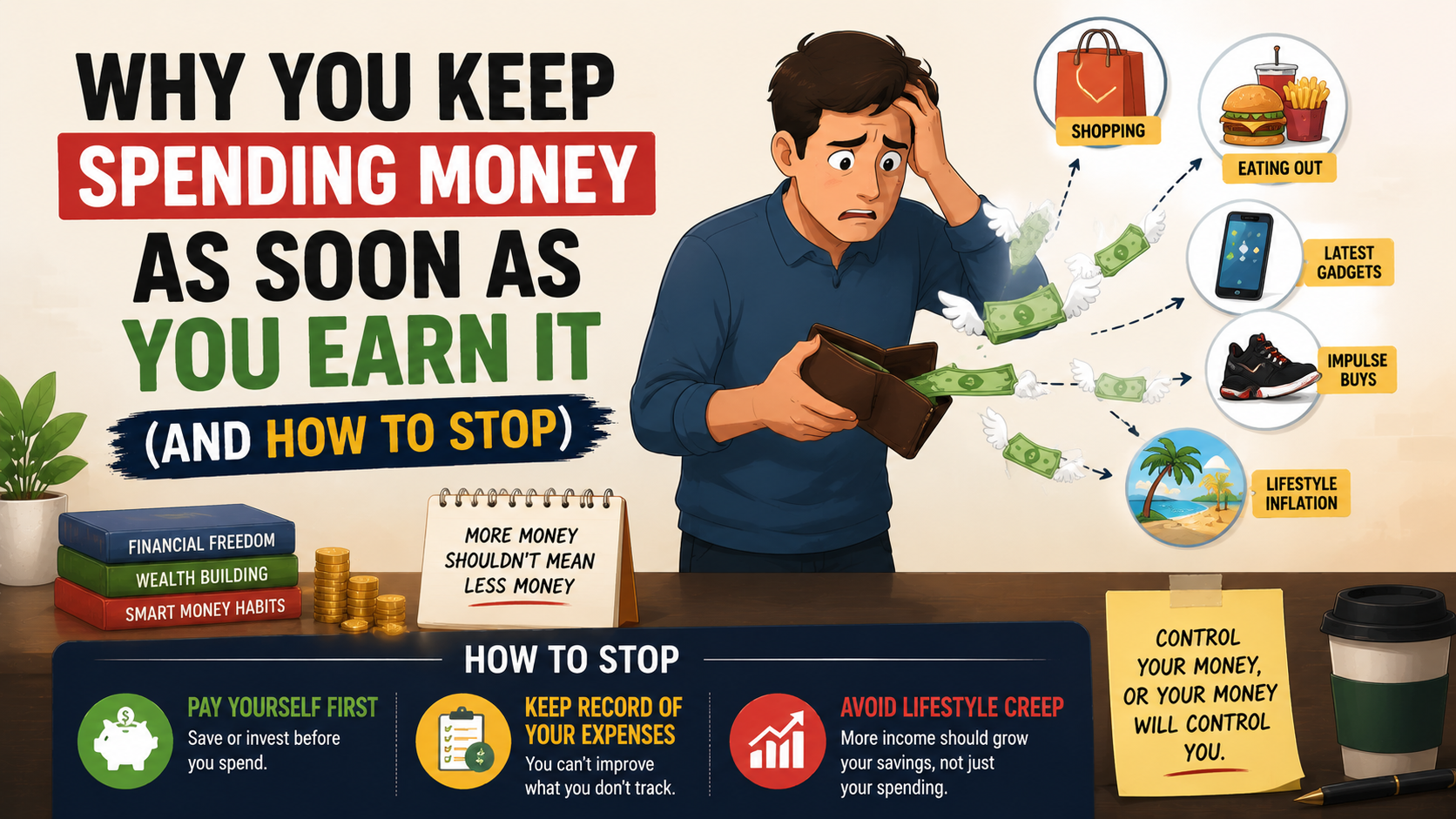
When I sold my first 10 pieces of watches and jewelry, I should have been celebrating a milestone. Instead, a few weeks later, I sat staring at my account, wondering where all the money went. I could not point to a single record. No sales log, no expense tracker, no separation between business money and personal money. The money came in, and it quietly left, and because I never wrote anything down, there was no accountability, no moment where I had to look at the numbers and explain my own spending to myself.
If money seems to disappear the moment it enters your hands, this article is for you. Let me walk you through why this happens and exactly how to stop it.
Why Does Money Disappear As Soon As You Earn It?
Let me ask you something honestly: can you say, right now, exactly where your last income went? Not roughly. Exactly.
If you cannot, you are not alone, and you are not careless or bad with money. What you are experiencing has specific, fixable causes. Spending money as soon as you earn it is rarely about the amount you make. I have seen people earning very little manage to save consistently, and I have watched people with high incomes, including my early business self, end every month with nothing.
The difference is almost never income. It is systems, awareness, and psychology. Let’s break down each cause.
Why You Keep Spending Money As Soon As You Earn It
1. You Have No Record of Where Your Money Goes
This was my biggest mistake with those first 10 sales. Without a spending record, money becomes invisible. Every small purchase feels harmless in the moment because nothing forces you to see the total.
Here is the uncomfortable truth I learned: what you do not track, you cannot control. When I finally started recording every sale and every expense from my watch business, the first month of data embarrassed me. Small “insignificant” spending like transport here, airtime there, small treats had quietly consumed a large portion of my profit.
How to stop it: Track every expense for the next 30 days. Use a simple notebook, a notes app, or a free spreadsheet. Do not try to change your spending yet; just record it. Awareness alone changes behaviour more than most people expect.
2. You Treat Income As Permission to Spend
Be honest with yourself for a moment: when money arrives, what is your first instinct? For most people, the arrival of income triggers a mental green light, like now I can finally buy that thing.
This is called spending psychology at work. Money arriving creates a feeling of abundance, and that feeling demands expression. The purchase is not really about the item; it is about the emotional release of finally being able to spend.
I felt this exact rush after my first sales. The money felt like a reward for my effort, so I “rewarded” myself repeatedly until there was nothing left to show for 10 sales.
How to stop it: Create a mandatory waiting period between receiving money and spending any of it. Even 48 hours breaks the emotional link between earning and immediately spending. The excitement fades, and clearer decisions follow.
3. You Have No Separation Between Money Types
One of the most expensive lessons from my business: when business money and personal money live in the same account, they become one pool and that pool always drains.
Read, 10 Boring Habits That Will Make You Rich (They’re Not Flashy. They Just Work)
Every income from my watch sales sat in the same place as my personal spending money. So when I bought something personal, it never felt like I was touching business capital. But I was. By the time I wanted to restock inventory, the capital had been eaten by dozens of small personal purchases.
How to stop it: Separate your money the moment it arrives. At minimum: one account or wallet for savings, one for necessary spending, and, if you run any business, one strictly for business capital. The physical separation creates a mental barrier that a single account never will.
4. You Are Paying Yourself Last
Here is a question worth sitting with: who gets your money first every month? The data plan? The food vendor? The landlord? Everyone except you?
Most people spend first and save whatever remains, and whatever remains is usually nothing. Paying yourself first flips this completely: the moment income arrives, a fixed portion goes to savings before a single expense is paid.
When I finally applied this to my business, I committed a fixed percentage of every sale to savings before touching anything. It felt uncomfortable for exactly one month. Then it became automatic, and for the first time, my sales actually accumulated into something.
How to stop spending it all: Choose a percentage, even 10 percent, and move it to a separate place the moment money arrives. Treat it as a bill you owe your future self, as non-negotiable as rent.
5. Lifestyle Creep Is Quietly Raising Your Expenses
Have you noticed that no matter how much more you earn, you never seem to have more left over? That is lifestyle creep, the silent habit of upgrading your spending every time your income increases.
Better phone. Better outfits. More frequent outings. None of these feel like big decisions individually. But together, they ensure your expenses permanently rise to meet your income, keeping you at zero no matter how much you make.
I watched this happen in my own business. Every time sales improved, my personal spending mysteriously improved with it. The business grew; my savings did not.
How to stop it: Whenever your income increases, decide in advance what percentage of the increase you will save or reinvest before you allow yourself a single upgrade. Growth should build your future first, your lifestyle second.
6. Your Money Has No Assigned Job
Money without a purpose gets spent. It is that simple. When income arrives without a plan, every temptation becomes a valid destination for it.
Ask yourself: before your last income arrived, did you already know what it was for? Or did you decide after it landed?
How to stop it: Give every amount a job before it arrives. This is the core of budgeting, not restriction, but assignment. So much for savings, so much for essentials, so much for business, so much for enjoyment. Money with a job resists temptation. Money without one surrenders instantly.
7. You Are Spending to Feel Something, Not to Get Something
This one requires real honesty. Sometimes spending has nothing to do with need. It is emotional relief. Stress spending. Boredom spending. Celebration spending. Comparison spending after scrolling through other people’s highlights online.
I noticed this pattern in myself during slow business weeks. When sales were quiet and I felt anxious, I would spend on something small just to feel a moment of control or comfort. The purchase never solved the anxiety. It just moved money out of my account.
How to stop it: Before any unplanned purchase, ask yourself one question: am I buying this thing, or am I buying a feeling? If it is a feeling, the purchase will not satisfy it, and naming that honestly, in the moment, stops a surprising number of transactions.
How to Break the Cycle — Your 30-Day Plan
You do not need to fix everything at once. Here is a simple sequence:
Read, What Are the 7 Levels of Wealth? A Simple Guide to Where You Stand (And Where You’re Going)
Week 1: Track every single expense. Change nothing. Just record.
Week 2: Separate your money — savings, spending, and business capital, if you have one, into different places.
Week 3: Apply paying yourself first. Move a fixed percentage to savings the moment any income arrives.
Week 4: Review your tracking from the past three weeks. Identify your top three money leaks and assign every expected income its job for the following month.
This is essentially the system I wish I had before those first 10 sales. It would have turned my earliest business success into a foundation instead of a lesson.
The Real Lesson From My First 10 Sales
Looking back, losing that money was not really about discipline. It was about the absence of a system that made my own spending visible to me. Without records, there was no accountability. Without separation, there was no protection. Without a plan, there was no direction.
The moment I introduced even a basic structure like tracking, separation, and paying myself first, the exact same income started producing completely different results. Nothing about my earnings changed. Everything about my awareness did.
If money keeps disappearing as soon as you earn it, do not start by blaming yourself. Start by building the system that makes your money visible. Discipline follows awareness far more easily than it follows guilt.
Frequently Asked Questions
Is it bad to spend money on enjoyment at all?
Not at all. The goal is not to eliminate enjoyment spending but to plan for it deliberately. An enjoyment budget you assigned in advance is healthy. Unplanned emotional spending that erases your savings is the problem.
How much should I save from each income?
Start with whatever percentage you can sustain consistently — even 5 to 10 percent. Consistency at a small percentage builds the habit, and the habit matters more than the amount in the beginning.
What if my income is irregular?
Irregular income makes these systems more important, not less. Use percentages instead of fixed amounts. A percentage of every payment goes to savings and essentials regardless of the payment size, so the system flexes with your income instead of breaking.
If this article was helpful, share it with your friends and follow me on Facebook, X (formerly Twitter), and YouTube
Leave a Reply