
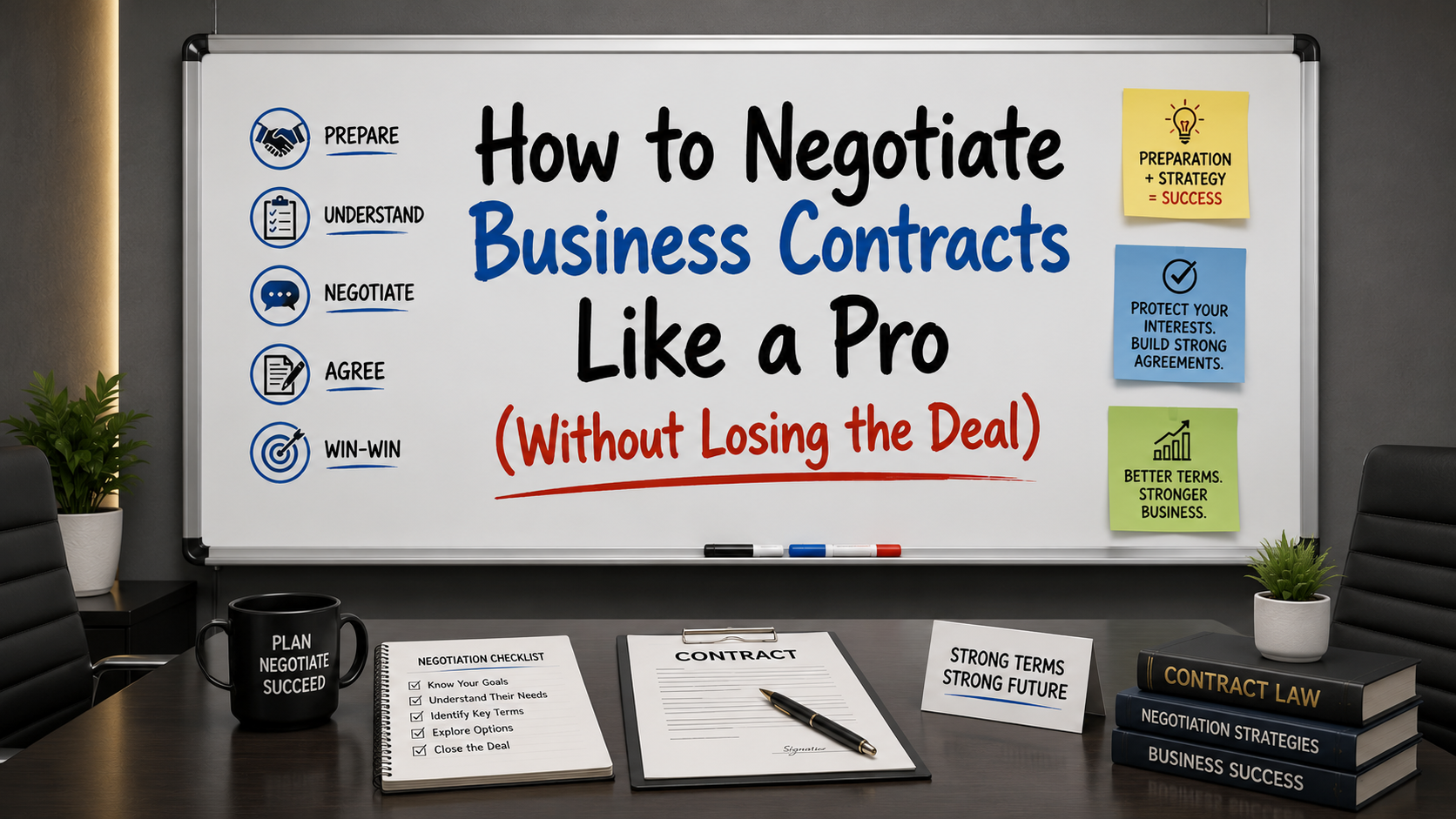
Early in my freelance journey, I lost more contracts than I won, not because my pricing was wrong or my service was weak, but because of how I opened the conversation. I would walk into a negotiation talking about what I needed, what my rates were, and what I required upfront. By the time I finished my opening statement, the client had already mentally moved on to the next seller.
It took me losing several deals to realise the problem was never my offer; it was my approach to negotiating business contracts. The people who consistently win deals do not lead with their needs. They lead with proof, preparation, and leverage. And in this article, I am going to break down exactly how to negotiate contracts the right way, without losing the deal before the conversation even gets started.
What Is a Business Contract Negotiation?
A business contract negotiation is the process of discussing and agreeing on the terms of a deal between two parties, such as the pricing, deliverables, timelines, and obligations, before formalising an agreement. It is not simply stating your price and waiting for a yes. It is a structured conversation where leverage, preparation, and presentation determine who walks away with the better outcome.
Most people treat negotiation as a confrontation. The professionals who consistently close deals treat it as a demonstration of value, proof, and confidence. Now, how do you negotiate a business contract?
How to Negotiate Business Contracts Like a Pro
1. Research the Client’s Business Before You Say a Word
The single biggest mistake I made early on was entering conversations without doing my homework. Walking into a negotiation blind means you are reacting to information instead of leading with insight.
How to apply this: Before any meeting or call, research the client’s business thoroughly, such as their website, their social media presence, their competitors, and any visible gaps in their current marketing or operations. Open the conversation by saying something like, “I analysed your business and here is what I found”, then present specific, genuine observations.
This single shift changes the entire power dynamic. Instead of asking for work, you are demonstrating expertise before the client has spent a single dollar. This directly answers the searched question of how to prepare for a business contract negotiation.
2. Lead With Results, Not With Requirements
This was the core lesson behind my early failures. I used to open conversations explaining what I needed from the client, like payment terms, timelines, and resources. The professionals who win deals do the opposite. They lead with results first and let the conversation about logistics happen naturally afterwards.
How to apply this: If possible, offer a small free result upfront, like a sample piece of work, a mini audit, or a demonstration of capability, before discussing your full pricing. Once a client sees tangible results, the conversation shifts from “should I hire this person” to “how do we make this bigger together?”
This answers the search query how to negotiate a business deal by leading with value.
3. Build Leverage Before You Negotiate
Leverage is the single biggest factor separating people who win contracts from people who lose them on price alone. Leverage means walking into a negotiation already holding something the other side needs or wants, rather than asking for something you need from them.
Example for online services: If you are pitching a Facebook ad management contract, bring proof that you have already run successful campaigns, such as screenshots, case studies, or verified results. This transforms the conversation from “convince me you can do this” to “show me how we scale what you’ve already proven.”
Example for physical contracts: I know a man who won a major building contract not by quoting the lowest price, but by saying something far more powerful: “Give me a letter of intent (LOI) confirming the job is mine, and I will start the building immediately. I already own a building supply house/shop. You can pay me once your project receives funding.” While his competitors were quoting prices and waiting for deposits, he was already moving, already proving capability, already removing the client’s biggest risk: uncertainty about whether the work would actually begin.
A similar dynamic plays out with printing press owners who can begin printing books immediately because they already own the equipment, while competitors are still quoting prices and requesting deposits before they can even start. Owning the tools, the proof, or the resources needed to deliver immediately is one of the strongest forms of leverage available in any negotiation.
This answers the frequently searched question of how to use leverage when negotiating a contract.
4. Present Yourself With Confidence and Professionalism
Your appearance and demeanour communicate competence before you say a single word. This applies whether you are meeting in person or presenting yourself online through a video call, a proposal document, or even a LinkedIn profile.
How to apply this: Dress appropriately for the level of contract you are pursuing. A higher-value contract typically warrants a more formal, polished appearance. For online negotiations, ensure your video call background, lighting, and presentation materials look professional and intentional, not rushed or careless.
This is not superficial. Clients are constantly, often unconsciously, assessing whether you are someone who takes their business seriously enough to deliver on a serious contract. This answers the search query does appearance matter in business negotiations.
5. Make Your Offer Genuinely Irresistible
An irresistible offer removes hesitation by stacking enough value, risk reversal, and clarity that saying no feels harder than saying yes.
Read, How to Develop a Sales Plan That Drives Revenue (With Template)
How to structure this: Combine your core service with a guarantee, a clear timeline, and a removal of upfront risk wherever possible. Instead of “I charge $500 for this service,” try “I charge $500 for this service, delivered within 7 days, and if you are not satisfied with the first draft, I will revise it at no additional cost.”
This answers the searched query on how to make a business offer that clients cannot refuse.
6. Be Bold and State Your Value Directly
Many people undersell themselves during negotiations out of fear of losing the deal, hedging their language with phrases like “I think” or “maybe we could.” This uncertainty is contagious. If you sound unsure of your own value, the client will be unsure too.
How to apply this: State your value directly and confidently. “I can deliver this result for you” carries significantly more weight than “I think I might be able to help with this.” Boldness, when backed by genuine competence and preparation, consistently outperforms timid language in negotiation outcomes.
This answers how to negotiate confidently without sounding arrogant.
7. Understand the Client’s Real Priorities, Not Just Their Stated Ones
Clients often state a priority, usually price, that is not actually their primary concern once you dig deeper. Their real priority might be risk reduction, speed, reliability, or simply confidence that the work will actually get done.
How to apply this: Ask direct questions early in the conversation: “What is most important to you in this project? Is it speed, cost, or quality of outcome?” Their answer often reveals that price is a secondary concern compared to certainty and trust, which gives you room to negotiate terms beyond simply lowering your rate.
This answers the search query how to understand client priorities during contract negotiation.
8. Avoid Discussing Price Too Early
One of the most common negotiation mistakes is jumping into price discussion before establishing value. Once price becomes the first topic, the entire conversation risks being reduced to a simple comparison against competitors.
How to apply this: Delay pricing discussion until after you have demonstrated your understanding of the client’s business, presented relevant proof of capability, and ideally shown some form of preliminary result or insight. By the time price comes up, the client is evaluating your value, not just comparing numbers.
This answers when should you discuss pricing in a contract negotiation.
9. Know Your Walk-Away Point Before You Start
Every negotiation should have a clear minimum threshold below which you are willing to walk away from the deal entirely. Without this clarity, it is easy to get pressured into unfavourable terms in the moment.
How to apply this: Before any negotiation, decide privately on your minimum acceptable price, timeline, or terms. If the conversation moves below that threshold, be prepared to politely decline rather than accept a deal that damages your business in the long term.
This answers the searched question of how to know when to walk away from a business negotiation.
10. Follow Up With Clear, Written Terms
Verbal agreements create confusion and disputes later. Once terms are agreed upon, document them clearly and promptly to avoid any ambiguity about deliverables, timelines, and payment structure.
How to apply this: Send a written summary immediately after any verbal agreement. Even a simple email outlining what was discussed and agreed before drafting a formal contract. This protects both parties and demonstrates professionalism.
This answers how to formalise a business contract after negotiation.
How My Approach Changed After Learning These Lessons
After realising my opening statements were costing me deals, I completely restructured how I entered every negotiation. I started researching the client’s business beforehand, leading with specific insights rather than my own requirements, and bringing proof of past results before any pricing conversation began. The shift was immediate as clients started treating me as someone evaluating their fit for the project, rather than the reverse.
Frequently Asked Questions
How do I negotiate a contract if I have no previous case studies or proof of results?
Offer a small, free sample of your work specifically tailored to the client’s business as your proof. A genuine, specific demonstration of capability can substitute for formal case studies, especially early in your career.
Is it bad to discuss price first in a negotiation?
It is not inherently bad, but it significantly weakens your negotiating position if value and credibility have not been established first. Delaying price discussion until after demonstrating genuine understanding and capability typically produces better outcomes.
How important is appearance in online business negotiations?
Very important. Your video call setup, your proposal documents, and your overall professionalism in digital communication directly influence how seriously a client takes your ability to deliver on a contract.
Leave a Reply